.avif)


Why Choosing Between Heating System Types for New Construction Is One of the Most Important Decisions You'll Make
When it comes to choosing between heating system types for new construction, the decision you make before the walls go up will shape your comfort, your energy bills, and your home's layout for decades to come. Heating accounts for roughly 29% of the average U.S. utility bill — and in the Pacific Northwest, that number can climb even higher. Get it right from the start, and you'll enjoy consistent warmth, lower operating costs, and a system that works with your home instead of against it. Get it wrong, and you may be stuck with a system that's difficult or expensive to change later.
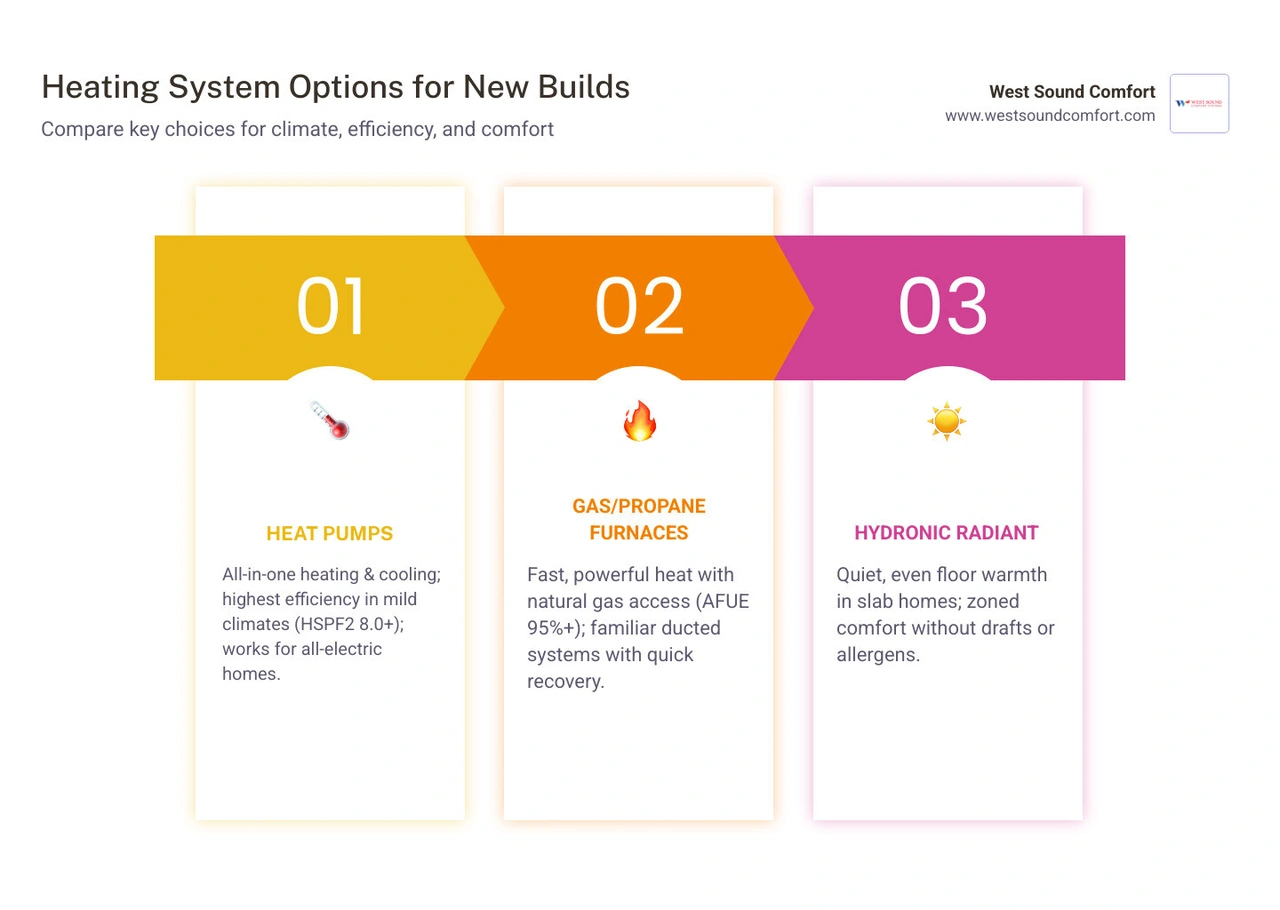
Here's a quick overview of the main heating system types to consider for a new build and what each one is best suited for:
• Air-source heat pump — Best For: Mild to moderate climates; all-electric homes — Key Advantage: Heats and cools; highest efficiency
• Cold-climate heat pump — Best For: Colder regions with occasional freezes — Key Advantage: Efficient down to very low temps
• Gas/propane furnace — Best For: Areas with natural gas access; fast heat demand — Key Advantage: Familiar, powerful, lower upfront cost
• Hydronic radiant (in-slab) — Best For: Slab-on-grade homes; comfort-focused builds — Key Advantage: Even, quiet, allergen-free warmth
• Ductless mini-split — Best For: Zoned rooms; additions; no-duct layouts — Key Advantage: Room-by-room control; easy install
• Geothermal heat pump — Best For: Large lots; long-term efficiency goals — Key Advantage: Extremely efficient; ground-stable temps
• Electric resistance baseboard — Best For: Small spaces; backup heat only — Key Advantage: Low install cost; high operating cost
The best choice depends on your climate zone, fuel availability, floor plan, insulation levels, and whether you want a combined heating and cooling solution. In most new builds across the Pacific Northwest — including Kitsap, Mason, and Jefferson Counties — a cold-climate heat pump or a hydronic radiant system paired with a heat pump tends to deliver the best balance of comfort and long-term value.
I'm Ernie Bogue, co-owner of West Sound Comfort Systems, and after more than three decades in the trades — with a deep specialty in hydronic heating systems — I've guided countless homeowners through choosing between heating system types for new construction, helping them avoid costly mistakes before a single wall goes up. In the sections ahead, I'll walk you through everything you need to know to make a confident, well-informed decision for your new build.
Choosing Between Heating System Types for New Construction Starts With the House
Before we talk equipment, we need to talk about the house itself. In new construction, the heating system should be selected to match:
• Local winter conditions in Kitsap, Pierce, Mason, Clallam, and Jefferson Counties
• Square footage and ceiling heights
• Insulation and air sealing quality
• Window size, placement, and performance
• Floor plan and zoning needs
• Available fuels such as electricity, natural gas, or propane
• Electrical service capacity
• Whether you also want cooling and better humidity control
A tight, well-insulated home needs much less heat than an older drafty house. That sounds obvious, but it changes everything. A home with excellent air sealing and windows may perform beautifully with a smaller heat pump than many people expect.
The home’s shell matters as much as the equipment
This is where Manual J load calculations come in. Manual J estimates how much heating and cooling your home will actually need based on insulation, windows, orientation, infiltration, and room-by-room details.
In plain English: better shell, smaller load, better system match.
If you skip this step, you risk oversizing the equipment. Oversized systems often short-cycle, meaning they turn on and off too often. That can reduce efficiency, wear parts faster, and create uneven comfort. Undersized systems can struggle during cold snaps. Neither is fun.
A whole-house approach matters too. Research shows that combining efficient equipment with insulation, air sealing, and good thermostat strategy can cut energy use by around 30%. Equipment alone cannot fix a weak building envelope.
Why choosing between heating system types for new construction is easier before framing is finished
The best time to decide is early, ideally before framing is complete. That gives you room to plan:
• Duct routes and return air paths
• Mechanical room size and access
• Slab prep for radiant tubing
• Thermostat locations
• Zoning by floor or living area
• Electrical panel capacity
• Future-ready wiring for controls or backup heat
Changing direction later can be expensive and awkward. Designing first and hoping the equipment fits later is like buying shoes before checking your size.
The Main Heating Systems to Consider for a New Build
Most new-home heating decisions come down to a few core system types. Each has a strong use case.
Heat pumps: the all-in-one choice for heating and cooling
Heat pumps move heat instead of generating it through combustion. That transfer-based approach is why they are so efficient. They also provide cooling, which is a major advantage in newer homes that hold heat well during warmer summer periods.
For many homes in our region, heat pumps are the leading option because they:
• Heat and cool with one system
• Work very efficiently in mild and marine climates
• Pair well with all-electric home designs
• Can be ducted or ductless
• Often qualify for incentives, depending on program rules and product eligibility
Important ratings include:
• SEER2 for cooling efficiency
• HSPF2 for heating efficiency
In 2026, higher HSPF2 and SEER2 numbers generally indicate stronger performance. Cold-climate heat pumps are especially worth considering in areas that see freezing winter mornings.
Research also points to major bill savings potential. Depending on the region and energy prices, homeowners may save 30% to 60% on heating bills by switching from a gas furnace to a heat pump.
Forced-air furnaces: familiar, fast, and fuel-dependent
Furnaces remain a common choice, especially where natural gas is available. They heat air quickly and distribute it through ductwork. For homeowners who like fast temperature recovery, that can be appealing.
Furnaces are typically powered by:
• Natural gas
• Propane
• Electricity
If you're comparing furnace efficiency, look at AFUE, or Annual Fuel Utilization Efficiency. High-efficiency furnaces and condensing boilers can reach ratings up to about 98%, while much older systems may be dramatically less efficient.
Furnaces make the most sense when:
• Natural gas access is reliable
• You want strong airflow from a central ducted system
• You prefer one familiar system for heating, paired with separate cooling if needed
The tradeoff is that a furnace-only setup does not provide cooling by itself, so new construction homeowners often end up planning an AC system too.
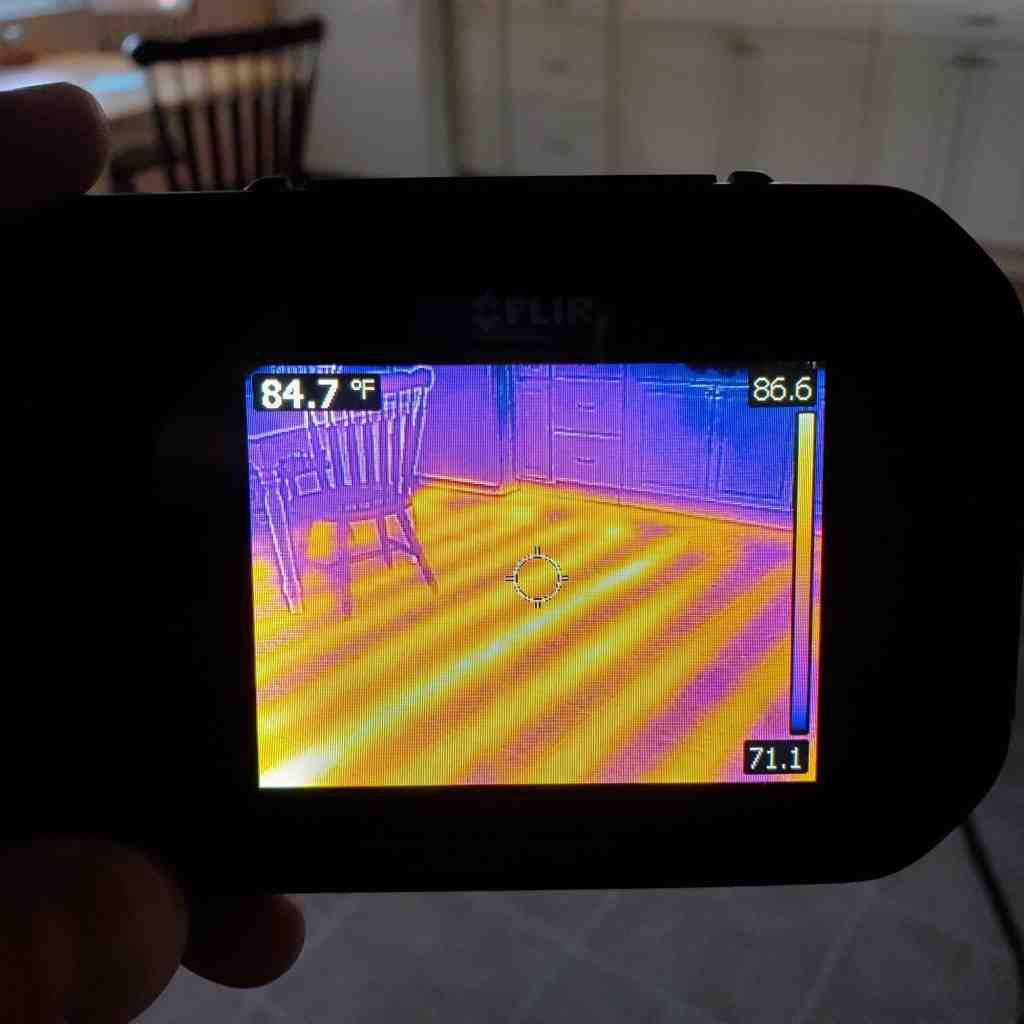
Hydronic and radiant systems: quiet, even comfort underfoot
Hydronic systems circulate heated water through tubing or radiators. In new builds, radiant floors are especially attractive because they can be designed right into the slab or subfloor.
Benefits include:
• Very even heat
• Quiet operation
• Less air movement and dust circulation
• Excellent comfort on tile, stone, or finished concrete floors
• Strong zoning potential
Radiant heat warms surfaces and people more directly instead of blasting warm air through the house. Many homeowners describe it as the most comfortable heat they have ever lived with. We agree, especially when it is designed properly from day one.
If you want to learn more about slab applications, here is a helpful resource on hydronic radiant floor heating in concrete slab.
When geothermal or electric resistance heat fits the plan
Geothermal heat pumps use stable ground temperatures to provide highly efficient heating and cooling. They can be a great fit when the lot, budget priorities, and site conditions all support loop installation. For long-term efficiency goals, geothermal deserves a look. You can read more about geothermal installation and repair service in Poulsbo WA.
Electric resistance heat, including baseboards, is simple but usually best reserved for:
• Small spaces
• Supplemental heat
• Backup applications
It is efficient at the point of use, but the operating cost is usually much higher than a heat pump. In a whole-home new build, it is rarely the first choice unless the home is very small or the system serves as limited backup heat.
Heat Pumps vs. Furnaces vs. Radiant: Which System Fits Your Priorities?
The best system is not always the same as the most popular system. It depends on what matters most to you.
• Efficiency — Heat Pump: Excellent — Forced-Air Furnace: Good to excellent, depends on AFUE and fuel — Hydronic Radiant: Excellent when well designed
• Cooling — Heat Pump: Included — Forced-Air Furnace: Separate system needed — Hydronic Radiant: Separate cooling needed
• Comfort feel — Heat Pump: Steady air-based heat — Forced-Air Furnace: Fast, warmer supply air — Hydronic Radiant: Even, quiet surface warmth
• Noise — Heat Pump: Low — Forced-Air Furnace: Moderate — Hydronic Radiant: Very low
• Air movement — Heat Pump: Yes — Forced-Air Furnace: Yes — Hydronic Radiant: Minimal
• Zoning — Heat Pump: Good — Forced-Air Furnace: Good — Hydronic Radiant: Excellent
• Fuel dependence — Heat Pump: Electricity — Forced-Air Furnace: Gas, propane, or electric — Hydronic Radiant: Usually boiler-based or heat-pump-assisted
• Best fit — Heat Pump: All-electric homes, mixed seasons — Forced-Air Furnace: Gas-access homes, fast heat demand — Hydronic Radiant: Comfort-first custom builds
Choosing between heating system types for new construction when efficiency is the top goal
If efficiency is your top goal, heat pumps usually lead the conversation. They transfer heat rather than create it through combustion, which is why they can outperform many conventional systems in our local climate.
That said, system efficiency on paper is only part of the story. Real-world performance also depends on:
• Tight duct design
• Proper sizing
• Good commissioning
• Insulation and air sealing
• Smart thermostat setup
A 98% AFUE furnace sounds impressive, and it is, but it still does not cool the house. A high-performing heat pump can cover both heating and cooling in one package, which is a major advantage for new construction.
Best fit by climate, fuel availability, and home design
Across the Olympic Peninsula and nearby counties, our marine climate often favors heat pumps. Winters are cool and damp, not usually deep-freeze conditions for long stretches. That makes cold-climate heat pumps especially practical.
Other local fit factors include:
• Natural gas availability: if available, a furnace may be worth considering
• Propane-only areas: workable, but tank placement and refills need planning
• All-electric homes: heat pumps are usually the natural fit
• Slab-on-grade homes: radiant in-slab heat can be excellent
• Large custom homes: zoning becomes more important
In colder pockets or for homeowners who want a safety net, hybrid or dual-fuel systems can make sense. These pair a heat pump with a furnace so the system can switch fuels when outdoor conditions call for it.
Ducted vs. ductless: which distribution method makes sense?
Ducted systems are ideal when:
• You want hidden distribution
• The floor plan supports central air movement
• You want one integrated heating and cooling system
• The build allows well-designed duct chases
Ductless systems are ideal when:
• You want room-by-room control
• The design has separate wings or bonus spaces
• You want to avoid bulky duct runs
• You are heating additions, studios, or detached spaces
Mini-splits are especially useful in homes where zoning matters. Ducted systems tend to win on aesthetics for whole-home uniformity, while ductless systems win on flexibility and zoned control.
Design the Home Around the Heating System, Not After It
This is one of the biggest new-build advantages: you can plan the house and the comfort system together.
Planning electrical, ductwork, and mechanical space early
If you're building around a heat pump, make sure the electrical design supports it. Panel size, breaker space, and any backup heat all need to be accounted for early.
You should also plan for:
• Air handler or furnace closet dimensions
• Filter access
• Service clearances
• Fresh air ventilation
• Duct chases and returns
• Outdoor unit placement with noise and maintenance access in mind
A beautiful mechanical room nobody can service is not actually beautiful.
Flooring, slabs, and hydronic details that affect comfort later
Radiant systems are especially sensitive to early design choices. For example:
• In-slab tubing must be planned before concrete is poured
• Floor coverings affect heat transfer
• Manifold locations matter for service and zoning
• Response time differs between slab systems and lightweight floor systems
Tile and concrete work very well with radiant. Thick carpet, not so much. If radiant heat is on your wish list, plan the flooring package with that in mind.
For more detail, see licensed radiant floor heating contractor in Poulsbo WA and radiant heat installation repair Bainbridge Island WA.
Integrating smart controls and domestic hot water
Modern systems should work with how you actually live. That may include:
• Smart thermostats
• Multi-zone controls
• Remote monitoring
• Ventilation integration
• Domestic hot water planning
If you're coordinating a heat pump water heater, tankless system, or combi-style hydronic setup, the plumbing and mechanical design should be coordinated early. Here is a useful comparison on tankless vs tank water heater comparison.
Sizing, Ratings, Maintenance, and Incentives: The Details That Make or Break Performance
This is where good equipment can become great, or disappointing.
Proper sizing is non-negotiable in new construction
Manual J is for load calculation. Manual S helps select the equipment. Manual D addresses duct design. Together, these are the backbone of a system that performs well.
Common mistakes include:
• Choosing equipment by square footage alone
• Oversizing "just to be safe"
• Skipping room-by-room calculations
• Poor return air planning
• Undersized ductwork
• Hiding equipment where maintenance is difficult
• Forgetting future additions or bonus rooms
• Installing radiant without coordinating flooring and controls
Oversized systems short-cycle. Undersized systems struggle. Bad duct design creates hot and cold rooms. New construction gives you the chance to avoid all three.
Which efficiency ratings actually matter in 2026
In 2026, these are the main ratings homeowners should know:
• AFUE: furnace and boiler heating efficiency
• SEER2: cooling efficiency for heat pumps and AC systems
• EER2: efficiency at higher peak conditions
• HSPF2: heat pump heating efficiency
ENERGY STAR certification is also worth watching because it can help identify better-performing systems and may connect to available incentives.
As a rule of thumb:
• Higher AFUE is better for furnaces and boilers
• Higher HSPF2 is better for heat pump heating
• Higher SEER2 is better for cooling efficiency
But remember: the best rating in the world cannot overcome poor installation.
Expected maintenance, lifespan, and rebate checkpoints
Every heating system needs maintenance. The difference is in what kind.
• Heat pumps: filter changes, coil cleaning, seasonal performance checks
• Furnaces: filter changes, combustion and safety checks
• Boilers and hydronic systems: annual service, pressure and control checks
• Radiant floors: occasional inspection of manifolds, pumps, and controls
Typical service life varies by system and maintenance quality, but many central systems can last 15 to 25 years or longer. Boilers and furnaces may last even longer in some cases, though efficiency declines with age.
Incentives can also influence the decision. Depending on the year, utility programs, federal tax credits, and product eligibility rules, high-efficiency heat pumps and other qualified systems may offer rebates or credits. We always recommend checking current program details before finalizing your equipment list.
How to Work With a Pro and Make the Final Choice
A good installation starts with good questions.
Questions to ask before the installation begins
Ask your HVAC partner:
• Will you perform a Manual J load calculation?
• How will the duct or hydronic distribution be designed?
• Do we need zoning?
• Where will returns and thermostats go?
• How will ventilation be handled?
• What happens during cold snaps?
• How will the system support future additions or finished spaces?
• What maintenance access should be built in?
If the answers are vague, that is your cue to slow down.
Final checklist for a confident new-build heating decision
Before you commit, review these homeowner steps:
1. Define your comfort priorities: speed, quiet, zoning, floor warmth, or all-in-one heating and cooling.
2. Confirm the fuel plan: electric, natural gas, or propane.
3. Match the system to the home design, not just the square footage.
4. Review insulation, windows, and air sealing before final equipment sizing.
5. Plan space for ducts, manifolds, filters, and service access.
6. Choose controls that fit your lifestyle.
7. Ask about maintenance needs and expected lifespan.
8. Verify current rebates or tax credits on qualifying equipment.
9. Schedule commissioning and startup testing.
10. Get a full homeowner walkthrough at the end.
Get local help for your project in Kitsap and nearby areas
If you're building in Kitsap, Pierce, Mason, Clallam, or Jefferson Counties, we can help you sort through the options before those choices get locked into framing, concrete, and electrical plans. Our team at West Sound Comfort Systems brings more than 30 years of experience to new construction HVAC planning, and we back our work with a 5-year warranty on parts and labor.
You can learn more about our local new construction services here:
• New Construction HVAC Poulsbo WA
• New Construction HVAC Port Orchard WA
• New Construction HVAC Bremerton WA
If you want a system that fits your floor plan, your comfort goals, and our local climate, now is the right time to plan it. Use our estimator tool to get your free online quote in minutes.
Trusted by Your Neighbors


Featured Manufacturer
Related Blogs
Identifying Hidden Water Leaks Behind Drywall Before the Rains Return
Why Electrical Panel Upgrades Are Crucial Before Switching to Fall Heating