.avif)

Why Homeowners in Kitsap County Are Choosing Radiant Heat
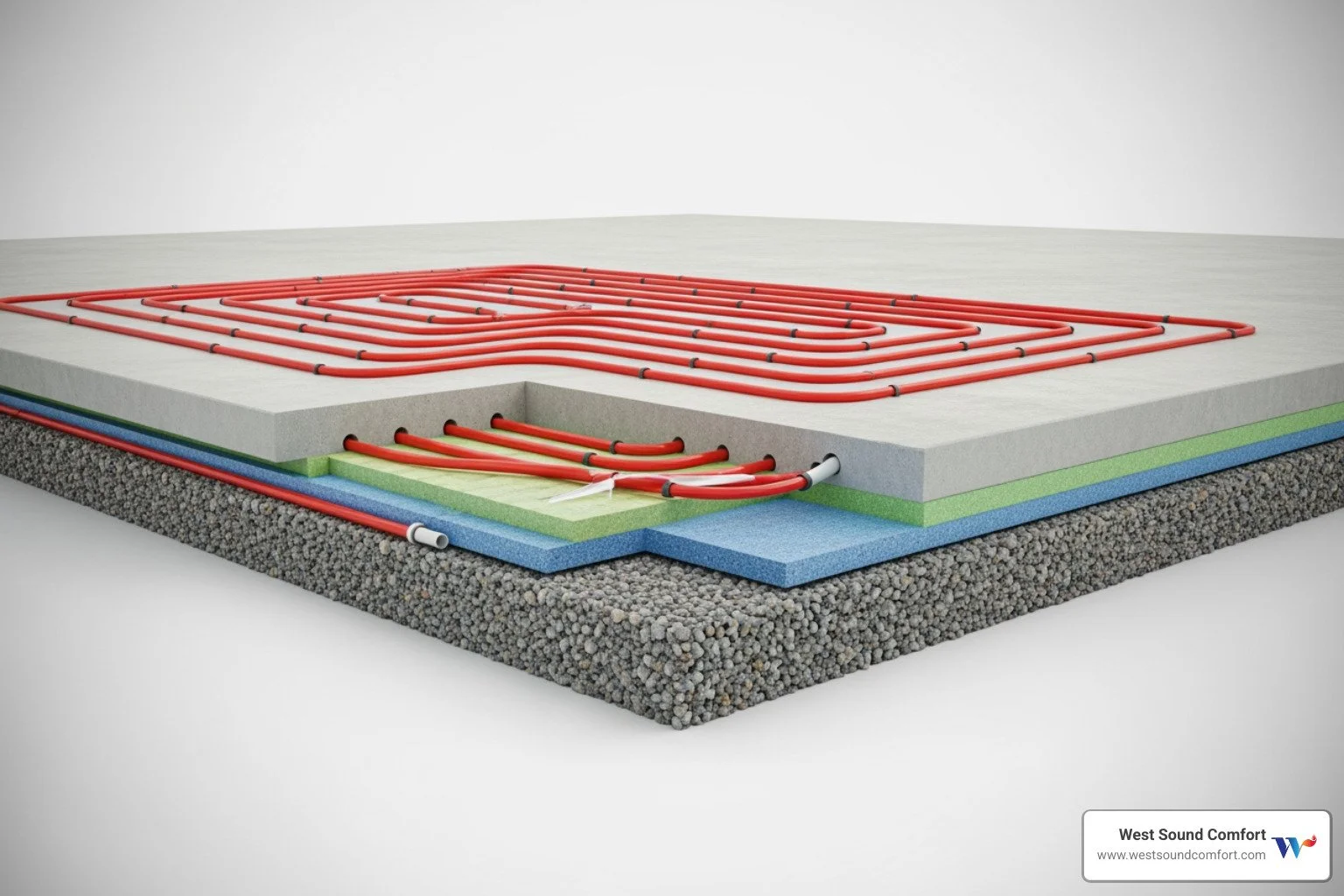
Hydronic radiant floor heating in concrete slab is a heating system where hot water flows through durable PEX tubing embedded in your concrete floor, delivering consistent, comfortable warmth from the ground up. Here's what makes it stand out:
- Superior Comfort: Even heat distribution with no cold spots or drafts
- Energy Efficient: Can reduce heating costs by 25-50% compared to forced-air systems
- Quiet and Clean: Silent operation with no dust or allergen circulation
- Long-Lasting: Tubing can last up to 100 years with minimal maintenance
- Versatile: Works with tile, concrete, stone, and many wood flooring types
If you're building a new home, adding a garage, or pouring a new slab in Kitsap County, this might be the smartest heating choice you'll ever make. The Pacific Northwest's damp, chilly climate makes floor heating especially appealing—imagine stepping onto a warm bathroom floor on a cold February morning, or working in a comfortably heated shop all winter long.
Many homeowners wonder if the upfront investment is worth it. The research is clear: radiant floors offer long-term energy savings, increased home value, and a level of comfort that forced-air systems simply can't match. No more noisy furnace cycles, no more dusty vents, and no more fighting over the thermostat.
For more information about efficient home heating options, check out our guide to boiler systems. If you're ready to explore radiant heating for your home, contact West Sound Comfort Systems to discuss your project.
I'm Ernie Bogue, co-owner of West Sound Comfort Systems, and I've spent over three decades specializing in hydronic heating systems right here in Kitsap County. My passion for hydronic radiant floor heating in concrete slab began in the late 1980s, and I've designed and installed countless systems that deliver the comfort and efficiency homeowners deserve.
Best Comfort and Air Quality
Imagine a home where every step you take is met with gentle warmth, where cold spots are a distant memory, and where the air feels fresh and clean. This isn't a dream—it's the reality of hydronic radiant floor heating in concrete slab. Unlike forced-air systems that blast hot air from vents, creating uncomfortable drafts and hot and cold zones, radiant heat warms objects and people directly. This means the warmth starts at your feet and permeates the entire room evenly, from the floor to the ceiling. It’s a comfort that people truly love and rave about.
One of the primary benefits we hear from our clients in Kitsap, Pierce, Mason, Clallam, and Jefferson Counties is the unparalleled comfort. The heat concentration remains in the lower half of the room, exactly where you need it most. This "bottom-up" heating method eliminates the need for higher thermostat settings because your body feels warmer at a lower ambient temperature.
Beyond comfort, radiant floor heating significantly improves indoor air quality. Forced-air systems circulate dust, allergens, and other particulates through ductwork, potentially triggering allergies and respiratory issues. Since radiant systems don't rely on blowing air, they eliminate this circulation, creating a healthier living environment for you and your family. For those with allergies, this can be a game-changer.
And let's not forget the peace and quiet. With no noisy furnaces kicking on and off, no whooshing air through vents, and no rattling ductwork, radiant systems operate in blissful silence. It's a subtle yet profound difference that contributes to a more serene and enjoyable home environment.
The Anatomy of a Hydronic Radiant Floor Heating in a Concrete Slab
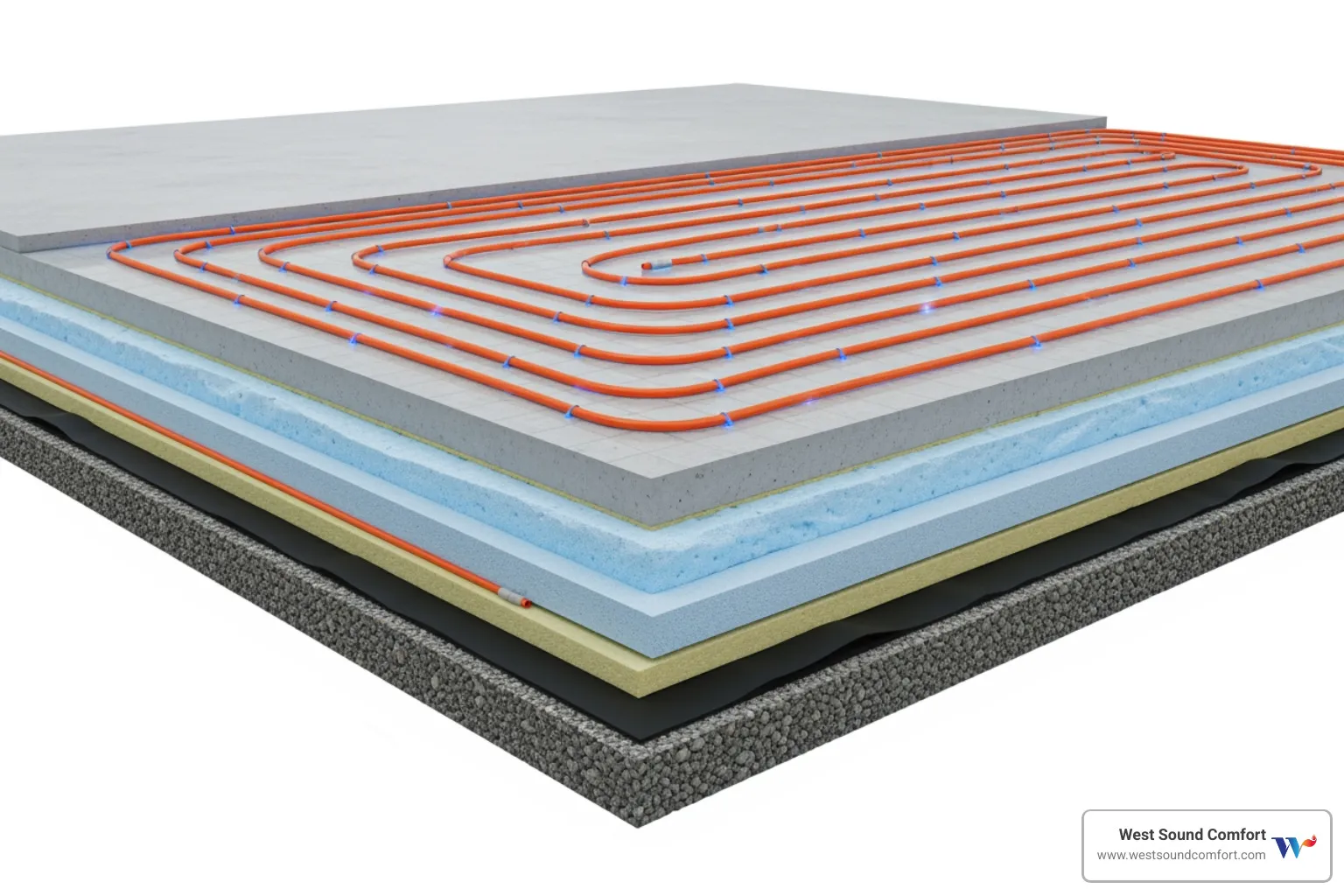
Understanding what goes into a hydronic radiant floor heating in concrete slab system helps explain its operation and highlights the precision involved in its installation. It's a carefully designed network of components working in harmony to provide reliable, efficient heat.
Core System Components
At the heart of every hydronic system are a few key players:
- Heat Source: This is typically a boiler system that heats the water to the desired temperature. Modern boilers are highly efficient and can be powered by natural gas, propane, or even electricity.
- Circulation Pumps: These pumps are responsible for moving the heated water from the boiler, through the PEX tubing embedded in your concrete slab, and back to the boiler. They are precisely sized to ensure optimal flow and even heat distribution.
- PEX Tubing with an Oxygen Barrier: This is the lifeline of your radiant system. PEX (cross-linked polyethylene) tubing is highly durable, flexible, and resistant to corrosion and extreme temperatures. The oxygen barrier is crucial for preventing oxygen from entering the system, which can cause corrosion in metal components like the boiler. Modern systems almost exclusively use PEX or rubber tubing with this barrier, a significant improvement over older copper or steel tubing that was prone to corrosion.
- Manifolds: Think of manifolds as the central nervous system of your radiant floor heating system. These copper or composite apparatuses distribute the heated water from the main supply line into individual tubing loops (circuits) within the concrete slab and collect the cooler water returning to the boiler. They often include shut-off valves and flow meters, allowing for precise control and zoning of different areas.
The Installation Process in a Concrete Slab
Installing hydronic radiant floor heating in concrete slab is a specialized process that, when done correctly, ensures decades of trouble-free warmth. While it might seem complex, it's a well-established procedure we've perfected over years of experience in Kitsap County and surrounding areas.
- Site Preparation and Vapor Barrier: The process begins with proper site preparation. A compacted aggregate base is laid, followed by a critical component: a vapor barrier. This heavy-duty polyethylene sheeting (often 6-8 mil thick) prevents ground moisture from migrating into your concrete slab, which is essential for maintaining the integrity of your slab and preventing moisture problems in your home.
- Under-Slab and Slab-Edge Insulation: This step is paramount for efficiency. Concrete is a massive heat sink, and without proper insulation, a significant amount of heat would be lost downwards into the earth and outwards through the slab edges. We recommend using rigid foam insulation, specifically Extruded Polystyrene (XPS) foam (often blue or pink board), for its excellent insulating properties and resistance to moisture absorption. This insulation creates a thermal break, ensuring that the heat is directed upwards into your living space. Slab-edge insulation is equally crucial, preventing heat loss to cooler foundation walls. For very large buildings, a strategy of decreasing insulation thickness from the perimeter inwards can be employed to use the earth's heat storage capacity.
- Attaching Tubing to Rebar or Mesh: Once the vapor barrier and insulation are in place, reinforcing steel (rebar or wire mesh) is laid down. This provides structural integrity to the concrete slab. The PEX tubing is then carefully laid out according to the system design and securely attached to the rebar or mesh using wire ties, nylon/plastic zip ties, or twine. This prevents the tubing from floating during the concrete pour.
- Proper Tubing Spacing: The spacing of the PEX tubing is crucial for even heat distribution. A certified radiant heating professional will design the layout based on your home's heat loss characteristics, room sizes, and desired warmth. For example, areas with higher heat loss, like perimeter walls or large windows, might have tubing spaced closer together (e.g., 8 inches on center) compared to interior areas (e.g., 16 inches on center). The goal is to ensure that no single area feels too hot or too cold.
- Pressure Testing Before the Pour: This is a non-negotiable step. Before any concrete is poured, the entire tubing system is charged with air, typically to 50 psi, and thoroughly inspected for leaks. This pressure test is maintained for several hours (at least two) to ensure there's no pressure drop, indicating a leak-free system. We also often maintain a reduced pressure (e.g., 25 psi) during the pour as a visual indicator of the system's integrity. This meticulous testing provides peace of mind, knowing your system is perfectly sealed within the slab.
- Pouring the Concrete Slab: With the tubing secured and pressure-tested, the concrete slab is then poured. Our teams work carefully to ensure the concrete completely encases the tubing without damaging it. Modern PEX tubing is surprisingly robust and can withstand the rigors of a concrete pour. Once poured, the concrete is allowed to cure properly, becoming the thermal mass that will efficiently store and radiate heat throughout your home.
This detailed approach ensures that your hydronic radiant floor heating in concrete slab system is installed to the highest standards, providing reliable and efficient warmth for decades.
Designing Your System for Peak Performance and Control
A well-designed hydronic radiant floor heating in concrete slab system is the key to maximizing comfort, efficiency, and control. It's not a "one-size-fits-all" solution; rather, it's custom to your home's unique characteristics and your lifestyle.
How to properly design your hydronic radiant floor heating in a concrete slab
Designing an effective radiant floor heating system requires careful consideration of several factors:
- Slab Thickness and Thermal Mass: The thickness of your concrete slab directly impacts its thermal mass—its ability to absorb, store, and slowly release heat. Thicker slabs (6 inches or more) have greater thermal mass, providing a longer "thermal swing" and potentially better protection against power outages, but they also have a slower response time. Thinner slabs (4-5 inches) respond more quickly. The design must account for this to ensure optimal comfort and efficiency.
- Building Insulation Levels: The overall insulation of your home is paramount. A well-insulated building requires less heat input, allowing the radiant system to operate at lower water temperatures and achieve higher efficiency. This includes wall insulation, window quality, and especially proper slab-edge insulation, which is critical for preventing heat loss. We perform a thorough assessment of your building's envelope to ensure the radiant system is appropriately sized.
- Room-by-Room Heat Loss Analysis: This is the cornerstone of any effective heating system design. A certified radiant heating professional will conduct a detailed heat-loss analysis for each room in your home. This involves calculating heat loss through walls, windows, ceilings, and floors, taking into account factors like room exposure (e.g., north-facing rooms lose more heat than south-facing ones), ceiling height, and desired temperature. This analysis dictates the amount of tubing needed, its spacing, and the overall system capacity, ensuring every space receives the perfect amount of heat.
- Professional Design importance: Given the complexities of heat loss calculations, tubing layout, and system integration, the design and layout of concrete floor radiant heat is often complex and should always be done by a certified radiant heating professional. While DIY kits exist, a professional ensures that the system is optimized for your specific home and climate, preventing costly inefficiencies or comfort issues down the line. Our expertise ensures your system is designed for peak performance and longevity.
The Impact of Flooring and Controls
The beauty of hydronic radiant floor heating in concrete slab is its versatility, but your choice of finish flooring does play a role in how efficiently heat is transferred into your living space.
Here's a general ranking of common flooring materials by their thermal conductivity (from best to good for radiant heat):
- Tile: Ceramic, porcelain, and natural stone are excellent conductors of heat, making them ideal partners for radiant floor heating. They absorb heat readily and radiate it effectively.
- Concrete: Polished or stained concrete floors are superb for radiant heating. Since the tubing is embedded directly within the concrete, there's no intermediary layer to impede heat transfer.
- Engineered Wood: Many engineered wood products are suitable, especially those designed for radiant heat applications. They tend to be more stable than solid hardwood in fluctuating temperatures.
- Vinyl and Linoleum: These materials can work well, provided they are rated for radiant heat.
- Carpet: While possible, carpet acts as an insulator. If you choose carpet, opt for thin carpeting with dense padding to minimize its insulating effect and ensure efficient heat transfer.
Thermostats and Floor Sensors: Modern radiant systems use advanced controls to optimize comfort and efficiency. While a simple floor thermostat might suffice for modest heating needs, homes in our region with significant heat loss or large temperature fluctuations often benefit from more sophisticated systems. These can include separate sensors for outdoor temperature (for "outdoor reset" functionality, which adjusts water temperature based on outside air), floor slab temperature, and room air temperature. This allows for precise control and prevents overheating or underheating.
Zoning with Manifolds: One of the most powerful features of hydronic radiant heating is its ability to create multiple heating zones. A "zone" is simply an area controlled by a single thermostat. Manifolds allow us to feed heated water to different zones independently. This means you can have your living room set to a comfortable 70°F, while a less-used guest bedroom is set lower, or a bathroom is programmed for a warm floor just before you wake up. Proper zoning ensures that one room doesn't become warmer than another, accommodating differences in sun exposure or usage patterns.
Smart Home Integration: Today's radiant heating systems can seamlessly integrate with smart home technologies. This allows you to control your home's temperature, adjust zoning, and even monitor energy usage from your smartphone, enhancing both convenience and energy efficiency.
Long-Term Value: Lifespan, Maintenance, and Key Considerations
Investing in hydronic radiant floor heating in concrete slab is a decision that pays dividends in comfort and efficiency for decades. Understanding the lifespan and maintenance requirements of these systems further underscores their long-term value.
Lifespan and Maintenance of System Components
One of the most compelling aspects of radiant floor heating is its incredible longevity:
- PEX Tubing Lifespan: The PEX tubing embedded in your concrete slab is designed to last an exceptionally long time. Manufacturers often rate it for 50 years or more, and many experts suggest it can realistically last up to 100 years. Once installed, the tubing generally does not require any upkeep. It's protected within the concrete, safe from UV degradation and physical damage, making it a truly "set it and forget it" component.
- Boiler and Pump Lifespan: While the tubing is virtually immortal, the mechanical components of the system, such as the boiler and circulation pumps, have a more typical lifespan for HVAC equipment. Boilers can last 15-20 years or more with proper care, and pumps also have a good operational life.
- Annual Boiler Maintenance: To ensure your system operates at peak efficiency and to maximize the lifespan of your boiler and pumps, annual professional maintenance is highly recommended. Just like your car needs a tune-up, your boiler benefits from regular checks. This includes inspecting components, cleaning, and ensuring all parts are functioning correctly. Regular maintenance can prevent unexpected breakdowns, like a boiler making noise in Poulsbo, WA, and ensures your system is ready for the cold season.
- Minimal Tubing Upkeep: As mentioned, the tubing itself requires virtually no maintenance once installed. The primary concern is preventing leaks during installation, which is why rigorous pressure testing before the concrete pour is so crucial.
Is a hydronic radiant floor heating in a concrete slab worth it?
The question of whether the initial investment in radiant floor heating is "worth it" is one we often hear. Our experience, backed by industry data, overwhelmingly points to yes, especially for homeowners in Kitsap, Pierce, Mason, Clallam, and Jefferson Counties.
- Slow Response Time Mitigation: One common concern about radiant heating, particularly with high-mass concrete slabs, is its slower response time compared to forced-air systems. It takes time for the concrete to heat up and radiate warmth. However, modern control systems, especially those with outdoor reset and smart thermostats, can effectively mitigate this. By anticipating heating needs based on external temperatures, the system can begin warming the slab proactively. Additionally, for situations where faster response is critical, low-mass over-slab systems or thinner concrete layers can be considered during design.
- Installation Complexity: While installing the tubing within a concrete slab is generally straightforward for professionals, the overall system design and integration with the boiler and controls can be complex. This is why professional installation is paramount. We handle the intricacies, ensuring your system is installed correctly and efficiently from day one.
- Long-Term Energy Savings vs. Initial Investment: While the upfront cost for a hydronic radiant floor heating in concrete slab system can be higher than a traditional forced-air system, the long-term energy savings are substantial. With heating costs potentially 25-50% lower, the system effectively pays for itself over its lifespan. When you factor in the extended lifespan of the tubing, the minimal maintenance requirements for the in-slab components, and the increased comfort, the return on investment becomes clear.
- Increased Home Value and Comfort: Beyond financial savings, radiant floor heating significantly improves your home's appeal and value. The unparalleled comfort, quiet operation, and improved air quality are highly desirable features for any homeowner. It transforms a house you like into a home you love, a place where every space feels inviting and warm. This emotional benefit, coupled with the tangible energy savings and longevity, makes it a truly worthwhile investment for your home.
Frequently Asked Questions About Radiant Floors in Concrete
How does radiant floor heating compare to forced-air systems?
Radiant heat provides more even, comfortable warmth without the noise, drafts, or allergen circulation common with forced-air systems. It heats objects and people directly, often allowing for lower thermostat settings and greater energy efficiency. Forced-air systems create convection currents, leading to hot spots near vents and cooler areas further away, as well as circulating dust and allergens. Radiant heat, in contrast, warms from the ground up, creating a consistent temperature throughout the room and a healthier indoor environment. It's truly a difference you can feel.
Can radiant tubing in a concrete slab leak?
Leaks are extremely rare with modern PEX tubing, which is durable and installed in a continuous loop without joints in the slab. The entire system is pressure-tested before the concrete is poured to ensure its integrity. This rigorous testing process, coupled with the inherent durability of PEX (which is corrosion-resistant and designed for long-term embedment), provides exceptional reliability. In the unlikely event of damage, repairs are possible by chipping away concrete around the affected area, installing a repair coupling, and protecting it. However, with proper installation, this is a concern you likely won't ever encounter.
What happens if the boiler or pump needs service?
The mechanical components, like the boiler system and pumps, are located in a utility space for easy access. They require periodic maintenance and can be repaired or replaced by a qualified technician without disturbing the floor. Our experienced technicians are adept at diagnosing and servicing these components, ensuring your system continues to run smoothly. Regular professional maintenance helps prevent unexpected issues and prolongs the life of these critical parts.
Conclusion: Step into a New Level of Home Comfort
Choosing hydronic radiant floor heating in concrete slab is more than just selecting a heating system; it's an investment in unparalleled comfort, significant energy savings, and a healthier home environment. From the moment you step onto a warm floor to the quiet, dust-free air you breathe, the benefits are clear and profound.
We've seen how these systems transform homes across Kitsap, Pierce, Mason, Clallam, and Jefferson Counties, providing consistent, luxurious warmth that homeowners love. With tubing designed to last up to 100 years and the potential to reduce heating costs by 25-50%, it's a smart, long-lasting investment that increases your home's value and livability.
While the installation requires professional expertise, the long-term rewards far outweigh the initial effort. At West Sound Comfort, we pride ourselves on designing and installing these sophisticated systems with precision and care, ensuring you receive the maximum benefit from your investment.
Ready to experience the concrete truth of radiant comfort for yourself? Learn more info about boiler-systems or contact us today to explore how a hydronic radiant floor heating system can lift your home comfort.
Trusted by Your Neighbors


Featured Manufacturer

Related Blogs

Repairing an R-22 AC Unit vs. Upgrading to a Modern Heat Pump This Summer

What Should My Thermostat Be Set To When I Leave for Summer Vacation?