.avif)


Stop Tanking Your Utility Bill: The Complete tankless vs tank water heater comparison for Pacific Northwest Homeowners
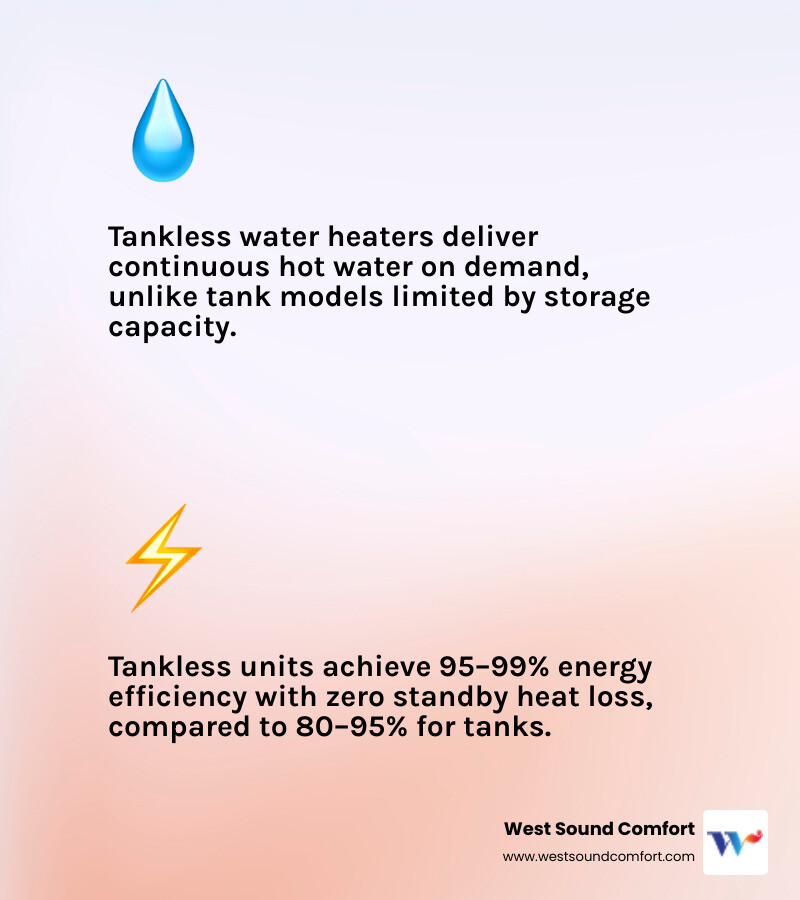
A tankless vs tank water heater comparison comes down to a straightforward trade-off: tank systems store and continuously heat a large supply of water, while tankless systems heat water only when you need it. Here's a quick look at how they stack up:
• Hot water supply — Tank Water Heater: Limited by tank size — Tankless Water Heater: Continuous, on demand
• Energy efficiency — Tank Water Heater: 80–95% — Tankless Water Heater: 95–99%
• Lifespan — Tank Water Heater: 8–12 years — Tankless Water Heater: 15–20+ years
• Space required — Tank Water Heater: Large floor footprint — Tankless Water Heater: Wall-mounted, compact
• Best for — Tank Water Heater: High simultaneous demand — Tankless Water Heater: Energy savings, smaller footprint
• Upfront cost — Tank Water Heater: Lower — Tankless Water Heater: Higher
• Standby heat loss — Tank Water Heater: Yes — Tankless Water Heater: None
For most Pacific Northwest homeowners, the right choice depends on your household size, how you use hot water day to day, and what your home's plumbing and gas or electrical setup can support. Both systems have real strengths — and real drawbacks worth knowing before you decide.
Water heating is the second-highest utility cost in most homes, right behind heating and cooling. So getting this decision right isn't just about comfort — it's about your energy bill every single month. Whether you're replacing a failing unit or planning ahead, understanding the key differences will save you from a costly mistake.
I'm Ernie Bogue, co-owner of West Sound Comfort Systems, and with over three decades in the trades — starting as a plumbing apprentice and growing into hydronic heating systems — I've helped hundreds of homeowners across Kitsap County and the Olympic Peninsula work through exactly this tankless vs tank water heater comparison. Let's walk through everything you need to know so you can make a confident, informed choice.
Understanding the Tankless vs Tank Water Heater Comparison
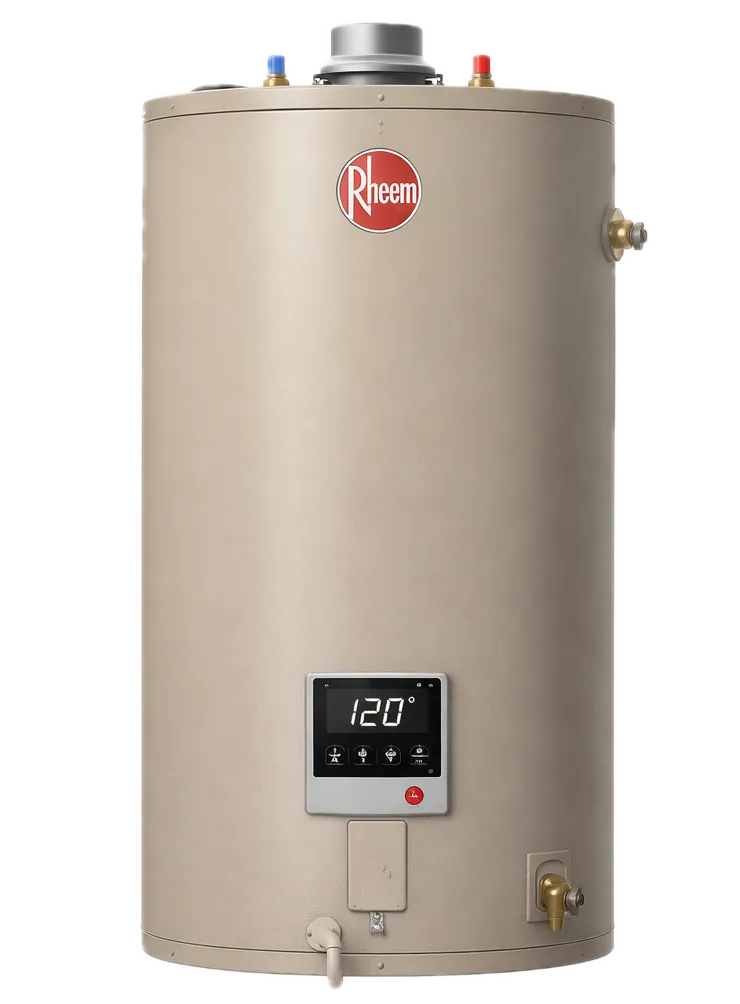
When we sit down with homeowners in Bremerton or Port Orchard, the first thing we explain is that these two systems represent two entirely different philosophies of home comfort. A traditional tank is like a giant thermos that keeps 40 to 80 gallons of water hot 24/7, just in case you need it. A tankless unit is more like a high-powered computer for your plumbing; it stays dormant until it senses water flow, then flashes that water to your desired temperature in seconds.
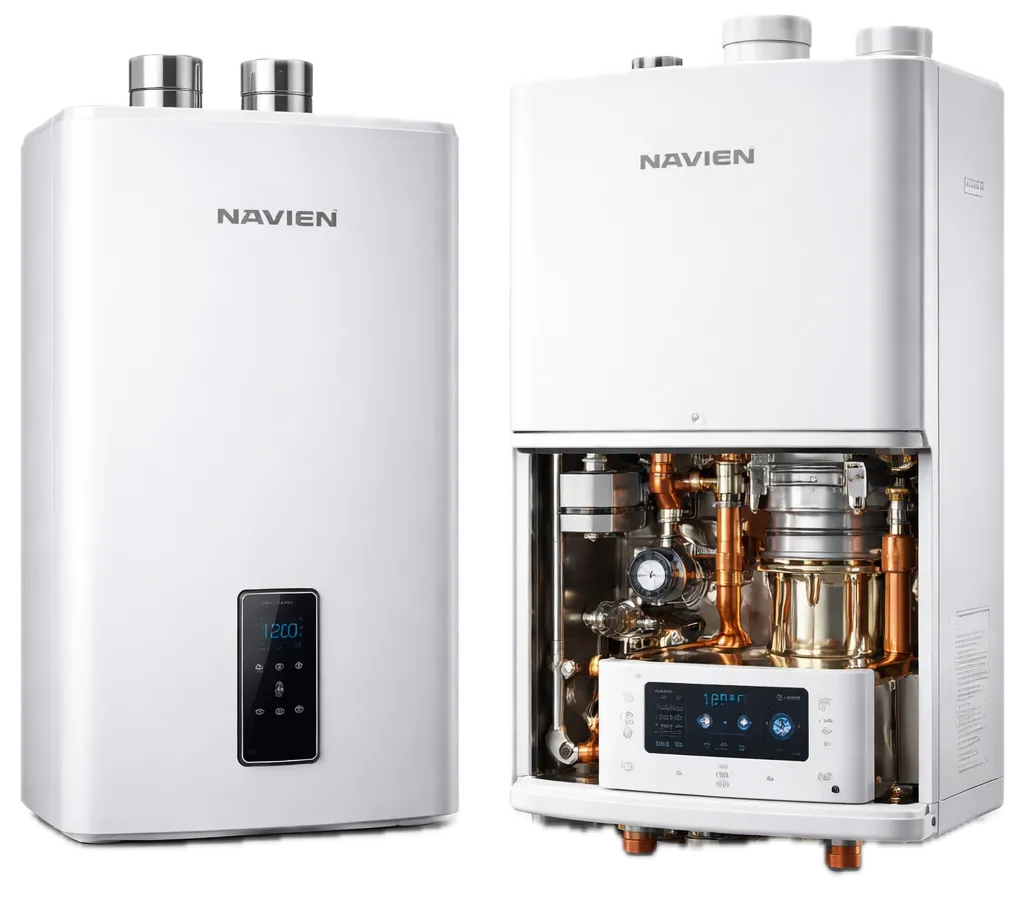
The tankless vs tank water heater comparison often highlights that tankless units are about the size of a large briefcase and mount to the wall, freeing up significant floor space. In contrast, a 50-gallon tank can take up to 9 square feet of space once you account for the necessary clearances. If you are looking into Water Heater Replacement, the footprint of the unit is often the first thing you’ll notice.
How Storage Tanks and On-Demand Systems Work
To understand why one might be better for your home, you have to look under the hood.
Traditional Tank Systems: These rely on a "dip tube" that carries cold water to the bottom of the tank. A gas burner assembly or electric heating elements then heat that water. A thermostat control monitors the temperature, and when it drops below your set point (usually 120°F), the heater kicks on—even if you’re asleep or at work. This is known as standby energy loss.
Tankless (On-Demand) Systems: When you turn on a hot water faucet, cold water travels through a pipe into the unit. A flow sensor triggers a gas burner or electric element, which heats a heat exchanger. The water circulates through this exchanger, reaching the set temperature almost instantly before heading to your tap. Because there is no storage, there is no standby loss.
Performance Differences in Simultaneous Hot Water Use
One of the most common questions we get for Water Heater Installation & Replacement Silverdale WA is: "Will I run out of hot water?"
The answer depends on how you use it. Tankless heaters provide an endless supply of hot water, but they have a limited flow rate, typically delivering 2–5 gallons per minute (GPM). If you try to run the dishwasher, the washing machine, and two showers at once, the unit may struggle to keep up, leading to a drop in water pressure or temperature.
Traditional tanks excel at high simultaneous demand because they have a large "buffer" of pre-heated water ready to go. However, once that 50-gallon tank is empty, you’re stuck with cold water until the tank recovers. To solve this with tankless technology, larger households often install multiple units or "point-of-use" models dedicated to specific bathrooms.
Energy Efficiency and Performance in the Pacific Northwest
In 2026, energy efficiency is more than just a buzzword; it's a financial necessity. According to the Department of Energy, tankless water heaters can be 24%–34% more energy efficient than conventional tanks for homes using 41 gallons or less of hot water daily. Even for high-usage homes (around 86 gallons per day), you’re still looking at an 8%–14% efficiency gain.
In some cases, a high-efficiency tankless unit can reduce water heating energy costs by 60% or more compared to a standard 50-gallon electric tank. This is why many homeowners seeking Water Heater Installation & Replacement Port Orchard WA are making the switch.
Maximizing Efficiency with a Tankless vs Tank Water Heater Comparison
When comparing models, look at the Uniform Energy Factor (UEF). The higher the number, the more efficient the unit.
• Intermittent Ignition Devices: Modern gas tankless units use electronic ignitions instead of standing pilot lights, which saves a surprising amount of gas over a year.
• Condensing Technology: Premier tankless models use a secondary heat exchanger to capture heat from exhaust gases that would otherwise be wasted. This pushes efficiency levels toward 99%.
For those considering Water Heater Installation & Replacement Gig Harbor WA, these technical upgrades are what turn a standard appliance into a long-term investment.
The Impact of Washington’s Climate on Groundwater Temperature
In the Pacific Northwest, our groundwater is cold—often dipping into the 40s during Olympic Peninsula winters. This is a critical factor in your tankless vs tank water heater comparison.
A water heater has to perform a "temperature rise." If your groundwater is 45°F and you want a 120°F shower, the unit has to raise the temperature by 75 degrees. This significantly impacts GPM output. A tankless unit that produces 7 GPM in Florida might only produce 4 GPM in Sequim. When we perform a Water Heater Installation & Replacement Sequim WA, we always size units based on these local temperature realities to ensure you aren't left with a lukewarm shower in January.
Longevity and Maintenance: Which System Lasts Longer?
Longevity is where the tankless system truly shines. A traditional tank water heater typically lasts 8–12 years. The constant cycle of heating and cooling, combined with water sitting in the tank, eventually leads to corrosion.
Tankless units, however, often have a lifespan of 15–20 years or more. Because they are built with serviceable parts, a skilled technician can often repair a specific component rather than replacing the entire unit. This durability is a major talking point for our Water Heater Repair Silverdale WA team.
Maintenance Requirements for Longevity
Don't let the longer lifespan fool you—tankless units are not "set it and forget it" appliances. They are actually more sensitive to water quality than tanks.
1. Vinegar Flushing: In areas with hard water, calcium and magnesium can scale up the heat exchanger. We recommend a vinegar flush or descaling every 1–2 years to maintain efficiency.
2. Anode Rods: For those with tank systems, replacing the sacrificial anode rod every 3–5 years is the best way to prevent the tank from rusting out.
3. Sediment Buildup: Both systems benefit from regular check-ups. If you notice popping sounds in your tank, it’s likely sediment buildup, and you should call for Water Heater Repair Port Orchard WA immediately to flush the system.
Safety Features and Risk Mitigation
Safety is a huge part of the tankless vs tank water heater comparison. Nearly 75% of tank heaters eventually burst or leak, which can spill 30 to 80 gallons of rusty water into your home. This is a nightmare if your heater is located in a finished basement or an attic.
Tankless units eliminate the risk of a massive flood because they don't store water. They also come equipped with advanced safety features like automatic shutoff sensors for overheating and pressure relief valves. For homeowners needing Water Heater Repair Bremerton WA, these safety upgrades provide significant peace of mind.
Choosing the Right Fit: Sizing and Household Needs
The "best" water heater is the one that fits your lifestyle. If you live alone in a small home on Bainbridge Island, a small tank or a point-of-use tankless unit might be perfect. If you have a family of six in Poulsbo, you need a system that can handle the "morning rush."
The space-saving wall-mount design of tankless units makes them ideal for modern homes or retrofits where you want to reclaim a closet. We often see this during Water Heater Installation & Replacement Bainbridge Island WA projects where every square foot of living space is valuable.
Sizing Your System for the Olympic Peninsula
Sizing isn't just about gallons; it's about "peak hour demand."
• For Tanks: We look at the First Hour Rating (FHR). A 75-gallon tank might be necessary for very large families.
• For Tankless: We calculate the GPM by adding up every fixture you might use at once.
Because of our groundwater temperatures, we typically recommend "oversizing" tankless units by about 20% compared to national averages. This ensures consistent performance during Water Heater Installation & Replacement Poulsbo WA jobs.
Deciding if a Tankless vs Tank Water Heater Comparison Favors Your Home
Is the higher initial investment for tankless worth it? It depends on your "ROI" (Return on Investment) timeline. If you plan to stay in your home for 15+ years, the energy savings and the fact that you won't have to replace the unit as soon as a tank model make it a clear winner.
However, you must consider the installation requirements. Switching from a tank to tankless often requires:
• Gas Line Upgrades: Tankless units need a lot of fuel quickly (up to 199,000 BTUs), which may require a larger gas pipe.
• Venting Requirements: They often require specialized stainless steel or PVC venting that must be routed to an exterior wall.
Our experts handling Water Heater Installation & Replacement Port Townsend WA can evaluate your current setup to see if these upgrades are feasible for your budget.
Frequently Asked Questions about Water Heaters
Which is better for a large family with multiple bathrooms?
For a large family, a high-capacity tankless unit (or two units plumbed in parallel) is often the best choice to ensure no one ever gets a cold shower. However, if the family frequently uses multiple high-flow fixtures simultaneously, a large, well-insulated storage tank might be the more practical and cost-effective solution.
Does a tankless water heater provide instant hot water?
This is a common myth. "Endless" is not the same as "instant." You still have to wait for the hot water to travel from the heater to the faucet. If your bathroom is far from the heater, you’ll still have a delay. To get truly instant hot water, you would need a recirculation pump.
Are heat pump water heaters a viable alternative in 2026?
Absolutely. In 2026, heat pump water heaters (also called hybrid heaters) have become the "third option." They are incredibly efficient—often 3 to 4 times more efficient than standard electric tanks—because they move heat rather than creating it. They are a fantastic middle ground for many Washington homeowners.
Conclusion
Choosing between a tank and a tankless system is a big decision that impacts your comfort for the next two decades. At West Sound Comfort, we bring over 30 years of experience to every home we visit across Kitsap County and the Olympic Peninsula. We aren't just here to sell you a box; we're here to design a system that works for your specific home and family.
We stand behind our work with a 5-year warranty on parts and labor, which is one reason why we maintain a 95% customer retention rate. Whether you need a Water Heater Installation & Replacement Bremerton WA, a quick fix via Water Heater Repair Poulsbo WA, or a full Water Heater Installation & Replacement, we are ready to help.
From the quiet shores of Water Heater Installation & Replacement Port Ludlow WA to the busy neighborhoods of Water Heater Installation & Replacement Kingston WA, our team is just a phone call away. We also serve:
• Water Heater Installation & Replacement Vashon WA
• Water Heater Installation & Replacement Belfair WA
• Water Heater Installation & Replacement Hansville WA
• Water Heater Installation & Replacement Indianola WA
• Water Heater Installation & Replacement Longbranch WA
Don't let your utility bill tank. Contact us today to find the perfect water heating solution for your Washington home.
Trusted by Your Neighbors


Featured Manufacturer
Related Blogs
Gas Furnaces vs. Dual-Fuel Heat Pumps for Pacific Northwest Winters

The Danger of Ignoring Minor Gas Smells Near Your Furnace in Early Fall