.avif)

Is Your Home Ready for Summer? What You Need to Know About Spring Heat Pump and AC Preparation
Spring heat pump and ac preparation is the single most effective thing you can do to keep your home cool and your energy bills in check before summer arrives. Here's a quick overview of what it involves:
1. Replace or clean air filters — improves airflow and can cut energy use by 5–15%
2. Clear the outdoor unit — remove debris and maintain at least 2 feet of clearance around the unit
3. Test your system in cooling mode — run it on a mild day before the heat sets in
4. Flush the condensate drain line — prevent clogs, water damage, and mold
5. Check and adjust thermostat settings — the U.S. Department of Energy recommends 78°F when home
6. Schedule a professional tune-up — covers refrigerant levels, electrical components, and coil cleaning
Most homeowners don't think about their cooling system until the first hot day of the year — and that's exactly when problems show up. After a long Pacific Northwest winter, your heat pump or AC has been sitting mostly idle. Dust settles on components, drain lines can develop algae, and small issues that went unnoticed during heating season are waiting to become expensive mid-summer repairs.
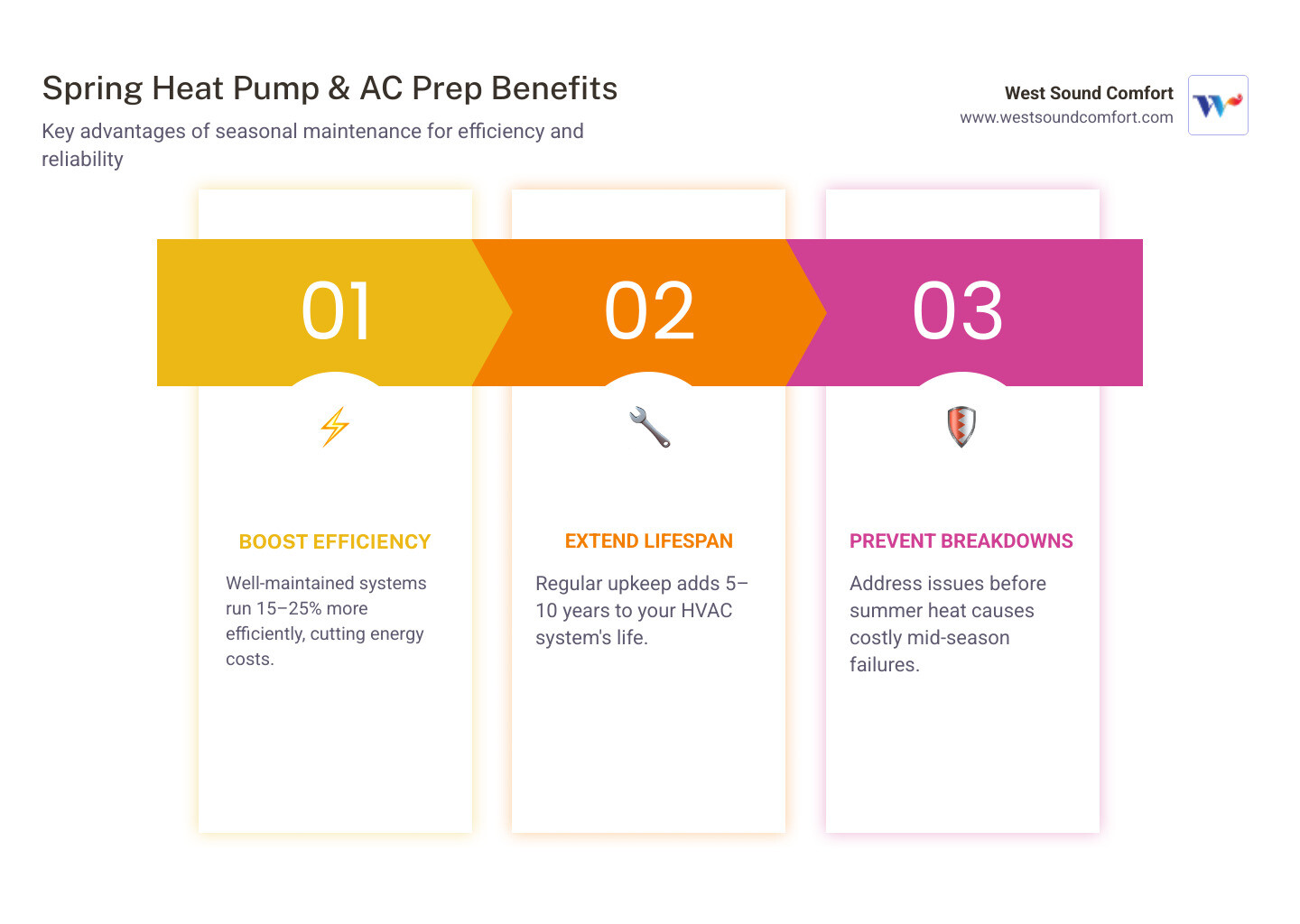
The good news? A little attention in spring goes a long way. Well-maintained systems run 15–25% more efficiently than neglected ones, and regular upkeep can add 5–10 years to your system's life. Whether you have a traditional central AC or a heat pump that does double duty year-round, spring is the right time to act — before the heat hits and technician schedules fill up fast.
I'm Ernie Bogue, co-owner of West Sound Comfort Systems, and with more than three decades in the trades I've seen how a proper spring heat pump and ac preparation routine can mean the difference between a comfortable summer and a stressful breakdown at the worst possible time. Read on for everything you need to know to get your system ready.
Why Spring is the Best Time for Heat Pump and AC Preparation
As we move through April 2026, the weather across the Olympic Peninsula is finally starting to turn. While we still have those crisp mornings in Bremerton and Port Orchard, the afternoon sun is a reminder that summer isn't far off. Spring is the "Goldilocks" season for HVAC maintenance—it’s not too hot, not too cold, and it’s the perfect window to ensure your system is ready for the heavy lifting ahead.
One of the biggest reasons to prioritize your spring heat pump and ac preparation right now is technician availability. Once the first 80-degree day hits the Kitsap Peninsula, our phones start ringing off the hook with emergency repair calls. By scheduling your maintenance in April or May, you beat the "summer rush." This allows for more flexible scheduling and ensures that if a part needs to be ordered, it arrives well before you actually need to flip the switch to cooling.
Furthermore, your system has likely been idle or working in heating mode for months. Dust, pollen, and debris from our lush Washington springs can clog up coils and filters. Addressing these issues now prevents the sudden "slugging" of a compressor or a blown capacitor when the system is suddenly forced to run at 100% capacity during a July heatwave. Beyond reliability, a well-prepped system runs much more efficiently. More info about heat pump service in Silverdale can help you understand how localized care keeps these units running at peak performance.
Essential DIY Maintenance Tasks for Homeowners
While some tasks require the specialized tools of a pro, there is plenty you can do yourself to jumpstart your spring heat pump and ac preparation. Taking an hour or two on a Saturday to walk through these steps can save you a significant amount of money on your utility bills.
Start by inspecting your indoor vents and registers. Over the winter, it’s common for furniture to get shifted or rugs to be placed over floor vents. Ensure all registers are open and unobstructed. Contrary to popular belief, closing vents in unused rooms doesn't save energy; it actually disrupts the pressure balance of your system and can lead to coil freezing or duct leaks. Aim to keep at least 80% of your registers open at all times.
Next, give your thermostat a quick "test drive." Switch it to "Cool" mode and set the temperature about five degrees below the current room temperature. Listen for the indoor blower to start and the outdoor compressor to kick on. After about 10 minutes, you should feel a steady stream of cool air. If you hear grinding noises or smell something burning, shut it off immediately and call for help. For those in the South Sound, More info about AC maintenance in Gig Harbor offers a great starting point for local homeowners.
Essential DIY Steps for Spring Heat Pump and AC Preparation
The most critical DIY task is air filter replacement. It sounds simple, but it’s the number one cause of system failure. During the high-pollen months in the Pacific Northwest, filters can clog faster than usual. We recommend checking your filter every 30 days and replacing it at least every 90 days.
• MERV Ratings: For most homes in Port Townsend or Sequim, a MERV 8 to MERV 11 filter provides a great balance between air filtration and airflow. Avoid high-MERV "hospital grade" filters unless your system was specifically designed for them, as they can restrict airflow and strain your motor.
• Energy Savings: Replacing a dirty filter can cut your cooling energy consumption by 5% to 15%. That’s a massive return on investment for a part that costs less than a lunch in downtown Poulsbo.
For more details on how this applies specifically to heat pumps, check out More info about heat pump maintenance in Bremerton.
Clearing the Outdoor Condenser Unit
Your outdoor unit (the condenser) is the "lungs" of your cooling system. It needs to breathe to release the heat it pulls from inside your home. Throughout the winter, wind and rain in places like Silverdale and Port Ludlow can pile up wet leaves, pine needles, and dirt against the unit.
1. Maintain Clearance: Ensure there is at least a 2-foot "dead zone" around the unit. Trim back any shrubs, weeds, or low-hanging branches.
2. Rinse the Fins: Use a garden hose (not a pressure washer!) to gently rinse the aluminum fins. Dust and cottonwood seeds can act like a blanket, trapping heat and forcing the unit to work 10–15% harder.
3. Check for Level: Over time, the concrete pad under your unit can settle. If the unit is tilting significantly, it can cause oil to settle in the wrong places and wear out the compressor. You can often use rot-proof shims to level it back up.
If you’re located near the water, More info about AC service in Port Orchard can help you navigate the specific challenges of salt air and moisture on outdoor equipment.
Maximizing Efficiency and Lowering Utility Bills
Efficiency isn't just about the machine; it's about the "envelope" of your home. In the Pacific Northwest, many older homes in areas like Bainbridge Island or Port Angeles have ductwork running through unconditioned crawl spaces or attics.
Statistics show that duct leaks can waste 20-30% of your cooled air before it ever reaches your living room. During your spring heat pump and ac preparation, take a peek at any visible ductwork. If you see gaps or feel air blowing out of joints, use mastic sealant (not duct tape!) to seal them up. This ensures the air you're paying to cool actually stays in the house.
DIY vs. Professional Maintenance: What’s the Difference?
• Replace Air Filters — DIY: Yes — Professional: Yes
• Clear Debris from Outdoor Unit — DIY: Yes — Professional: Yes
• Flush Condensate Drain — DIY: Yes — Professional: Yes
• Check Refrigerant Levels — DIY: No — Professional: Yes
• Inspect Electrical Connections — DIY: No — Professional: Yes
• Clean Evaporator/Condenser Coils — DIY: Surface Only — Professional: Deep Clean
• Calibrate Thermostat — DIY: No — Professional: Yes
• Lubricate Moving Parts — DIY: No — Professional: Yes
Professional Support for Spring Heat Pump and AC Preparation
While DIY tasks are great for maintenance, a professional tune-up is an investment in your system's longevity. A technician can spot a failing capacitor—a small part that often breaks during heatwaves—long before it leaves you sweating in the dark.
Professional service includes checking refrigerant levels. If your system is low, it likely has a leak. Running a system with low refrigerant is like driving a car with a hole in the radiator—eventually, the engine (or in this case, the compressor) will seize. We also tighten electrical connections, which can loosen due to the vibration of the unit. This simple step prevents "pitting" and electrical shorts. Well-maintained systems run 15-25% more efficiently than neglected ones. For those with specialized systems, More info about ductless mini-split service in Poulsbo is essential.
Thermostat Settings for Spring Heat Pump and AC Preparation
How you operate your thermostat is just as important as how you maintain the unit. The U.S. Department of Energy recommends setting your thermostat to 78°F when you are at home. While that might sound warm to some of us in the cooler Olympic Peninsula climate, using ceiling fans can make the air feel 5 degrees cooler, allowing you to stay comfortable at higher settings.
• Smart Thermostats: Upgrading to a smart thermostat can reduce cooling costs by 10-20%. These devices learn your schedule and automatically raise the temperature when you're at work or sleeping, ensuring you aren't paying to cool an empty house.
• The 5-Minute Rule: If you are manually switching your heat pump from heating to cooling, always wait at least five minutes between transitions. This allows the refrigerant pressures to equalize and prevents the compressor from locking up.
Thinking about a new system? More info about heat pump installation in Silverdale can help you choose a unit that integrates perfectly with modern smart controls.
Signs You Need Professional Service Immediately
Sometimes, spring heat pump and ac preparation reveals issues that a simple filter change won't fix. If you notice any of the following, it’s time to call in the experts before the summer heat makes the problem worse.
1. Short Cycling: If your AC turns on and off every few minutes without ever really cooling the house, it’s "short cycling." This puts immense strain on the motor and is often caused by a clogged filter, a failing thermostat, or a refrigerant issue.
2. Weak Airflow: If the air coming out of your vents feels like a gentle whisper rather than a steady breeze, you may have a failing blower motor or significant duct obstructions.
3. Odd Noises: Squealing, grinding, or banging sounds are never a good sign. They usually indicate a belt is slipping or a bearing is about to fail.
4. Ice on the Lines: If you see frost or ice on the copper lines leading to your outdoor unit—even if it's 80 degrees outside—stop! This usually means airflow is restricted or refrigerant is low. Running the system in this state can destroy the compressor.
5. Unusually High Bills: If your energy bill jumps significantly compared to April of last year, your system is likely losing efficiency and needs a calibration.
For a deeper dive into these warning signs, read our guide on 4 Signs Your AC Might Not Survive the Summer.
Frequently Asked Questions about Spring HVAC Maintenance
How often should I replace my air filters?
In the Pacific Northwest, we recommend checking your filter once a month. If you have pets, allergies, or live in a high-pollen area like Sequim, you’ll likely need to replace it every 30 to 60 days. At a minimum, change it every 90 days to prevent system strain.
What is included in a professional spring tune-up?
A comprehensive tune-up includes cleaning the condenser and evaporator coils, checking refrigerant charge, inspecting all electrical connections and capacitors, lubricating moving parts, clearing the condensate drain line, and testing the thermostat for accuracy. It’s a full "physical" for your cooling system.
How do I safely switch my heat pump to cooling mode?
Most modern thermostats handle this automatically if set to "Auto." If you do it manually, ensure the system has been off for at least five minutes before switching modes. This prevents "short cycling" the compressor, which can trip your circuit breaker or cause internal damage.
Conclusion
Taking the time for spring heat pump and ac preparation is the best way to ensure your family stays comfortable throughout the upcoming summer months. From the simple DIY tasks of changing filters and clearing brush to the technical precision of a professional tune-up, every step you take now pays off in lower bills and fewer headaches later.
At West Sound Comfort, we’ve spent over 30 years helping our neighbors in Kitsap, Pierce, Mason, Clallam, and Jefferson Counties stay comfortable. We stand behind our work with a 5-year warranty on parts and labor, and we’re proud of our 95% customer retention rate. Whether you're in Bremerton, Silverdale, Gig Harbor, or anywhere else on the Olympic Peninsula, we’re here to help you get your home ready for the season.
Don't wait for the first heatwave to find out your AC isn't up to the task. Schedule your spring maintenance today and breathe easy knowing your home is ready for whatever the Washington summer brings.
Trusted by Your Neighbors


Featured Manufacturer

Related Blogs
Why Does My Air Conditioner Smell Like Mildew in Late August?
How Short-Cycling Damages Your Compressor After a Long Summer