.avif)

What Size Water Heater Do I Need? Here's the Quick Answer
What size water heater do I need is one of the most common questions homeowners ask when their unit starts failing — and getting it wrong is one of the most costly mistakes you can make. Too small, and you're rationing hot showers. Too large, and you're paying to heat water you never use.
Here's a quick reference to get you started:
• 1-2 people — Tank Water Heater: 30-40 gallons — Tankless (GPM): 6-8 GPM
• 3-4 people — Tank Water Heater: 50-60 gallons — Tankless (GPM): 8-10 GPM
• 5-6 people — Tank Water Heater: 75-80 gallons — Tankless (GPM): 10-12 GPM
• 7+ people — Tank Water Heater: 80-100 gallons — Tankless (GPM): 12-14 GPM
These are solid starting points, but your actual size depends on more than just how many people live in your home. Peak hot water demand, fuel type, incoming water temperature, and your appliances all play a role — and on the Olympic Peninsula, that last factor matters more than most people realize.
A family of four in Kitsap County might use 100 gallons of hot water or more on a typical day — between morning showers, the dishwasher, and a load of laundry. And with cold Pacific Northwest groundwater temperatures, a water heater that works fine in warmer climates may leave you shivering here.
I'm Ernie Bogue, co-owner of West Sound Comfort Systems, and after more than three decades in the trades — starting as a plumbing apprentice and growing into a specialist in hydronic heating — I've helped hundreds of homeowners across Kitsap, Pierce, and Mason Counties answer exactly this question about what size water heater do I need. In this guide, I'll walk you through how to calculate the right size for your home, step by step.
Key Factors in Determining What Size Water Heater Do I Need
When we visit a home in Gig Harbor or Port Angeles to discuss a new unit, we look at several variables beyond just the number of bedrooms. While the April 2026 efficiency standards mean newer units are better than ever, they also have different physical footprints and performance curves.
The first thing to consider is occupancy count. How many people are actually living in the house? A retired couple in a four-bedroom house in Sequim has very different needs than a family with three teenagers in Bremerton. Next, we look at the number of bathrooms and the types of fixtures you have. High-flow "rain" showerheads or large soaking tubs require significantly more volume than standard fixtures.
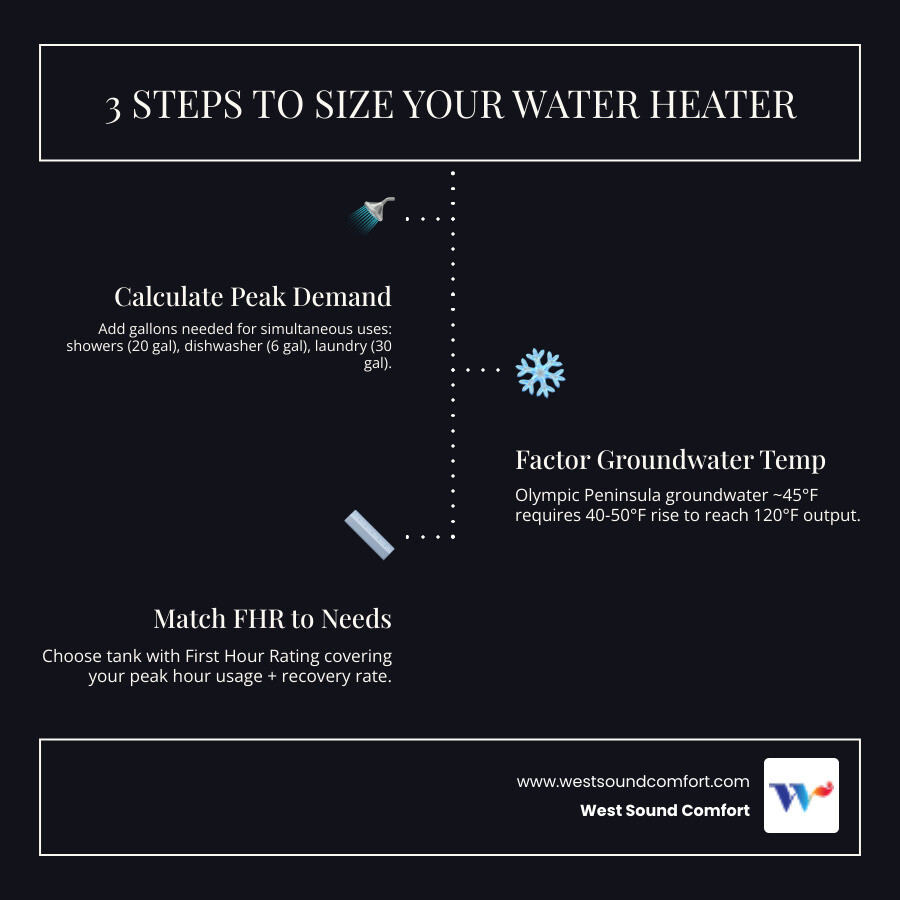
Simultaneous fixture use is the real "stress test." If your household typically runs the dishwasher while two people are showering, your peak demand is much higher. Finally, we must account for incoming groundwater temperature. In our part of Western Washington, groundwater can be quite chilly. Heating water from 45°F to 120°F takes more energy and time than it does in a warmer climate. If you're noticing your current unit isn't keeping up, it might be time for a professional Water Heater Replacement.
Understanding Tank Capacity vs. First-Hour Rating (FHR)
Many homeowners look only at the "tank size" (e.g., 50 gallons) printed on the side of the unit. However, the more important metric for your morning routine is the First-Hour Rating (FHR). You can find this on the yellow EnergyGuide label.
The FHR tells you how many gallons of hot water the unit can deliver in one hour, starting with a full tank. This number combines the storage volume with the recovery rate (how fast the unit can heat new water). For example, a high-quality 50-gallon gas heater might have an FHR of 90 gallons because it recovers quickly, whereas an electric model of the same size might only have an FHR of 65 gallons. When choosing a Water Heater Installation & Replacement in Bremerton WA, matching the FHR to your peak hour of usage is the secret to never running out of hot water.
How Fuel Type Affects Performance and Sizing
The "fuel" your home uses significantly impacts how we size your system.
• Natural Gas: These units generally have the fastest recovery rates. A 40-gallon gas unit can often outperform a 50-gallon electric unit because it heats water so quickly.
• Electric: These are common in rural areas of the Peninsula. Because they heat more slowly, we often recommend stepping up a tank size (e.g., moving from a 40 to a 50-gallon tank) to ensure you have a larger "buffer" of hot water.
• Heat Pump (Hybrid): These are incredibly efficient, often 2 to 4 times more efficient than standard electric tanks. However, they can have slower recovery rates in "heat pump only" mode, so sizing the storage tank correctly is vital.
• Propane: Similar to natural gas, propane offers excellent recovery speeds for homes in more remote areas of Mason or Clallam Counties.
If you are considering switching fuel types, our team can help with a Water Heater Installation & Replacement in Port Orchard WA to ensure your electrical panel or gas lines are ready for the change.
Calculating Your Household’s Peak Hot Water Demand
To accurately answer what size water heater do I need, we have to look at your "peak hour." This is usually the one-hour window in the morning or evening when your home is the busiest.
Think about your household's heaviest 60 minutes. Does it include three showers, a load of laundry, and someone shaving? Here is a breakdown of typical hot water usage per task:
• Shower: 20 gallons
• Bath: 30 gallons (standard) to 60+ gallons (soaking tub)
• Shaving: 2 gallons
• Hand Dishwashing: 4 gallons
• Automatic Dishwasher: 6–10 gallons
• Clothes Washer (Top-load): 25–40 gallons
• Clothes Washer (Front-load): 10–15 gallons
If your current unit is struggling to meet these demands, you might experience luke-warm showers or a total loss of hot water. In some cases, a Water Heater Repair in Silverdale WA can fix recovery issues caused by sediment or failing elements, but if the tank is simply too small, an upgrade is the only permanent solution.
Recommended Tank Sizes for Different Family Sizes
While every home is unique, we use these general guidelines as a starting point for storage tank heaters:
• 1–2 People — Demand Level: Low/Regular — Recommended Tank Size: 30–40 Gallons
• 2–3 People — Demand Level: Regular — Recommended Tank Size: 40–50 Gallons
• 3–4 People — Demand Level: High (Teens/Kids) — Recommended Tank Size: 50–60 Gallons
• 5+ People — Demand Level: High — Recommended Tank Size: 75–100 Gallons
What size water heater do I need for a family of 4?
For a standard family of four in Western Washington, a 50-gallon gas water heater is typically the "sweet spot." It provides enough volume for back-to-back showers and recovers quickly enough for evening chores.
However, if you have an all-electric home, we often suggest a 60-gallon tank or a high-recovery 5500W model to prevent "the cold shower lottery." If your family of four includes teenagers who take 20-minute showers, or if you have a massive garden tub, you may even want to look at a 75-gallon unit or a tankless option. Our experts specializing in Water Heater Installation & Replacement in Gig Harbor WA can help you decide if a larger reserve is worth the extra space.
Sizing Tankless and High-Efficiency Systems for the Olympic Peninsula
Tankless water heaters are a popular choice across the Olympic Peninsula because they provide "endless" hot water and save significant floor space. But sizing them is completely different from sizing a tank. Instead of gallons, we look at Gallons Per Minute (GPM) and Temperature Rise.
A tankless unit doesn't have a "reserve." It must be able to heat water instantly as it flows through the heat exchanger. This is where our local climate becomes a major factor. If the water coming into your home from the city main or your well is 45°F, and you want your shower at 120°F, the unit must provide a 75°F temperature rise. As the required temperature rise goes up, the GPM capacity of the unit goes down.
If you're in a colder part of the peninsula, a unit rated for 9 GPM in Florida might only give you 5 GPM here. This is why professional sizing for Water Heater Installation & Replacement in Poulsbo WA is so important.
Calculating GPM and Temperature Rise for Tankless Units
To size a tankless unit, we add up the GPM of every fixture you might use at the same time:
• Standard Shower: 2.5 GPM
• Low-Flow Shower: 1.5–2.0 GPM
• Kitchen Faucet: 1.5 GPM
• Bathroom Faucet: 0.5–1.0 GPM
• Dishwasher/Washer: 1.0–2.0 GPM
If you want to run two showers (5.0 GPM) and a kitchen sink (1.5 GPM) at once, you need a unit that can handle 6.5 GPM at a 70°F or 75°F rise. In Bainbridge Island, where many homes have multiple high-end bathrooms, we often install larger units to ensure no one gets a "cold surprise" when someone else turns on a tap. If you're planning an upgrade, consider our Water Heater Installation & Replacement in Bainbridge Island WA services to get the math right.
Sizing for Heat Pump and Solar Water Heaters
Heat pump water heaters (HPWH) are the "green" choice for many homeowners in Sequim and Port Townsend. Because they pull heat from the surrounding air, they require specific airflow requirements—usually about 700 to 1,000 cubic feet of air space. If you're putting one in a small closet, it may need a louvered door or ducting to work efficiently.
Solar water heaters are less common here but still viable. They are sized based on collector area (the panels on the roof) and the storage-to-collector ratio. Usually, we recommend about 20 sq. ft. of collector for the first two people and 12-14 sq. ft. for each additional person in our northern climate. For those in sunnier spots like Sequim, a Water Heater Installation & Replacement in Sequim WA can help you maximize these efficient technologies.
Installation Considerations and the Risks of Incorrect Sizing
Size isn't just about gallons; it's also about inches. Newer, high-efficiency water heaters are often taller and wider than the models they replace because they have thicker insulation. Before you buy, you must measure your physical dimensions and ensure you have the required 18-inch clearance in front of the service controls for future maintenance.
The Risks of an Undersized Unit:
• Frequent cold showers.
• The unit works harder, leading to a shorter lifespan.
• Inability to run multiple appliances simultaneously.
The Risks of an Oversized Unit:
• Higher energy bills (paying to keep 80 gallons hot when you only use 40).
• Higher initial purchase cost.
• Takes up unnecessary space in your home.
Whether you are in a historic home in Port Townsend or a new build in Silverdale, we ensure your installation meets all local codes, including seismic strapping. Check out our Water Heater Installation & Replacement in Port Townsend WA for a fit that's just right.
Frequently Asked Questions about What Size Water Heater Do I Need
Can I use multiple tankless water heaters for a large home?
Yes, this is often called "point-of-use" or "supplemental" heating. If you have a primary bathroom that is very far from the main water heater, we might install a small tankless unit just for that bathroom. However, for most homes, a single, correctly sized whole-home unit is more cost-effective and easier to maintain.
Does a larger water heater require a different electrical circuit?
It depends. If you are moving from a standard 40-gallon electric to a 50-gallon electric, your existing 30-amp breaker is usually fine. However, switching to a whole-home electric tankless unit often requires a significant electrical upgrade—sometimes needing two or three 40-amp or 60-amp breakers. Always consult an electrician or a full-service team like ours before making the switch.
How does hard water affect my water heater's capacity over time?
In areas with hard water, minerals like calcium and magnesium settle at the bottom of the tank. This sediment buildup can eventually take up several gallons of space, effectively "shrinking" your 50-gallon tank to 45 or 40 gallons. It also acts as an insulator, making it harder for the burner or element to heat the water. Regular flushing is key to maintaining your unit's capacity and efficiency.
Conclusion
Choosing the right water heater size is about balancing your family's daily "chaos" with long-term energy efficiency. At West Sound Comfort, we’ve spent over 30 years helping our neighbors in Kitsap, Pierce, Mason, Clallam, and Jefferson Counties find that perfect balance.
Whether you need a high-recovery gas tank in Bremerton or a space-saving tankless unit in Poulsbo, we stand behind our work with a 5-year warranty on parts and labor. We treat every home like our own, ensuring your new system is safe, efficient, and sized perfectly for your needs.
Ready to stop worrying about the hot water running out? Contact us today for a professional Water Heater Replacement and enjoy the comfort you deserve.
Trusted by Your Neighbors


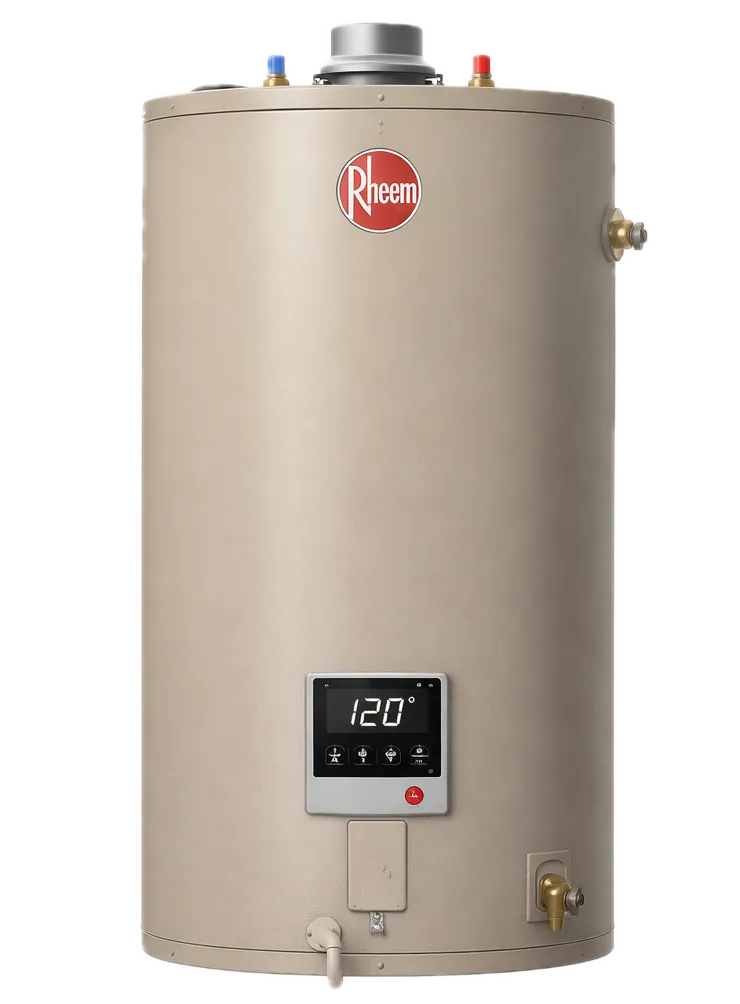
Featured Manufacturer
Related Blogs
Why We Recommend Scheduling Your Furnace Tune-Up Before the First Frost in Silverdale
Understanding the Lifespan of Your Capacitor After a Heavy Cooling Season