.avif)


Why the Pacific Northwest's Wind and Rain Season Demands Action Now
Protecting your home during windstorms and rain events is one of the most important things you can do as a homeowner on Washington's Olympic Peninsula. Here's a quick overview of the most effective steps:
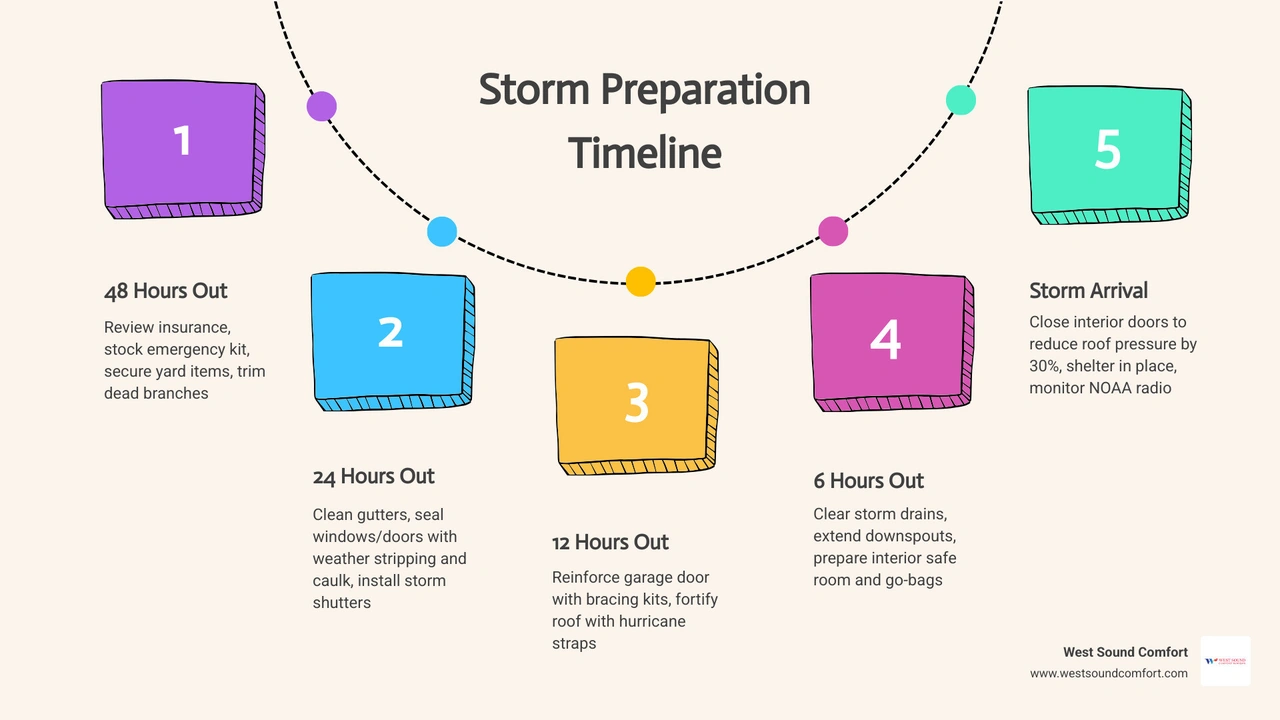
1. Review your insurance - Confirm you have coverage for wind, flood, and water damage before a storm hits.
2. Seal windows and doors - Use weather stripping, caulk, and storm shutters to block wind-driven rain.
3. Reinforce your garage door - It's the most vulnerable opening in your home during high winds.
4. Fortify your roof - Check shingles, clean gutters, and install hurricane straps.
5. Secure the yard - Bring in loose items, trim dead branches, and anchor sheds.
6. Stock emergency supplies - Keep a 3-5 day kit with water, food, a NOAA weather radio, and a flashlight.
7. Close interior doors during a storm - This simple step can reduce wind pressure on your roof by up to 30%.
Here in Kitsap County and across the wider Olympic Peninsula, wind and rain aren't seasonal visitors — they're year-round regulars. Storms roll in off the Pacific with little warning, and even moderate winds of 50 mph can lift shingles, expose underlayment, and let water pour into your attic before you've had a chance to react. The U.S. experienced more than 28 separate weather and climate disasters between 2023 and 2024, each causing over a billion dollars in damage — and flooding from rain and storm surges was among the most costly. Your home is likely your biggest investment. Treating storm preparation as optional is a risk most homeowners simply can't afford.
This guide walks you through every layer of storm defense — from your roof to your yard to your emergency kit — so you're ready well before the next big blow arrives.
I'm Ernie Bogue, co-owner of West Sound Comfort Systems and a trades professional with more than three decades of hands-on experience helping Pacific Northwest homeowners keep their homes safe and comfortable through every season. Protecting your home during windstorms and rain events is something I've seen up close — and in this guide, I'll share the practical, proven steps that make a real difference.
Strengthening the Envelope: Protecting Your Home During Windstorms and Rain Events
When we talk about "the envelope," we mean the physical barrier between your cozy living room and the chaos outside. In April 2026, as we face increasingly unpredictable weather patterns, maintaining this barrier is critical. If wind can find a way into your home, it creates internal pressure that pushes up on the roof and out on the walls—a recipe for structural failure.
The goal is to create a "continuous load path." This is an engineering concept where the roof, walls, and foundation are all tied together using metal connectors. This ensures that when the wind pulls on your roof, the weight of the entire house holds it down. For those living in high-wind areas like Port Angeles or Sequim, checking that your home meets ASTM E1996 standards for impact resistance can be the difference between a dry home and a total loss.
Sealing Windows and Doors for Protecting Your Home During Windstorms and Rain Events
Your windows and doors are the most likely points of entry for wind-driven rain. Once a window breaks, the wind funnels in, and the pressure can literally lift the roof off.
• Plywood Protection: If you don't have permanent storm shutters, 3/4-inch marine plywood is your best DIY friend. Don't just cut it to the size of the glass; ensure a four-inch overlap on all sides of the window frame. For masonry homes, use expansion bolts; for wood frames, use lag bolts that penetrate at least 1-3/4 inches into the solid framing.
• Pressure Relief: A professional tip is to drill small relief holes in the plywood to help equalize pressure, preventing the boards from being sucked off by high-velocity gusts.
• Doors: Standard entry doors can be a weak link. If you're upgrading, look for steel entry doors. For existing double doors, install heavy-duty slide locks at both the top and the bottom to prevent them from blowing inward.
• Sealing: Don't forget the basics. Fresh caulk around window frames and high-quality weather stripping under doors will block the "capillary action" that pulls water through tiny gaps during heavy rain events.
Strengthening Garage Doors for Protecting Your Home During Windstorms and Rain Events
Did you know that over 90% of home damage during major wind events starts with a garage door failure? Because they are so large, they act like sails. Once the door buckles or is pushed off its tracks, the wind enters the garage and exerts massive pressure on the ceiling and shared walls.
If your garage door doesn't have a wind-load rating or an impact-resistance sticker, you should consider a horizontal bracing kit. These kits involve heavy-duty steel bars that you bolt across the door panels to prevent them from flexing. Check your mounting brackets as well—many older homes in Port Orchard or Bremerton only have three or four brackets per side. Adding more can significantly increase the door's stability. If you see rusted pins or worn-out rollers, replace them now; you don't want a mechanical failure when the wind is howling at 70 mph.
Fortifying the Roof, Gutters, and Exterior Perimeter
Your roof is your first line of defense. While most modern homes are built to withstand gusts up to 110 mph, age and Pacific Northwest moisture can compromise that strength.
• Nailing — Standard Roof: Standard spacing — FORTIFIED Roof™ Standards: Enhanced ring-shank nails, tighter spacing
• Edge Metal — Standard Roof: Basic drip edge — FORTIFIED Roof™ Standards: Heavy-duty, specific attachment patterns
• Water Barrier — Standard Roof: Standard felt underlayment — FORTIFIED Roof™ Standards: Sealed roof deck (synthetic or taped seams)
• Shingles — Standard Roof: Standard asphalt — FORTIFIED Roof™ Standards: High-wind and impact-resistant (Class F/G/H)
Research shows that homes built to FORTIFIED standards are 34% less likely to file an insurance claim after a major storm. Even if you aren't replacing your whole roof, you can perform a 5-Step Checklist for Another Pacific Northwest Winter to catch loose shingles before they become "missiles."
In the attic, check for truss bracing. If you have a gabled roof (the ones that look like an "A"), the end walls are particularly vulnerable. Installing 2x4 braces that run the length of the roof can prevent the gable from collapsing inward or outward.
Gutter Maintenance and Drainage Solutions
In the Pacific Northwest, wind is usually accompanied by a relentless downpour. If your gutters are clogged with needles from our beautiful evergreens, water will overflow. This doesn't just damage your fascia boards; it pools at the foundation, leading to basement flooding or crawlspace moisture issues.
Install high-quality gutter guards to keep debris out, and ensure your downspout extensions carry water at least six to ten feet away from the foundation. If you have recurring puddles, consider French drains or permeable pavers to manage stormwater. For homes in low-lying areas of Gig Harbor or Poulsbo, installing backflow valves on your sewer lines is a smart move to prevent heavy rain from forcing sewage back into your home.
Securing the Yard and Landscaping
High winds turn common yard items into dangerous projectiles. I’ve seen gravel from landscaping embedded in siding and trampolines wrapped around power lines.
• The 40-Foot Rule: Try to keep large trees at least 40 feet away from your home. If that’s not possible, have a professional arborist remove dead limbs and thin out the canopy to reduce "wind sail" effect.
• Projectiles: Replace gravel or rock landscaping near the house with bark mulch or dirt. In a 70 mph gust, a piece of gravel is a bullet; mulch is just a mess.
• Anchoring: Secure sheds with ground anchors or cables. For trampolines and BBQs, either bring them inside the garage or use heavy-duty tie-downs. Even heavy patio furniture can "walk" across a deck and break a sliding glass door if not secured.
Interior Readiness and Emergency Planning
Once the exterior is as secure as possible, focus on the inside. Preparation isn't just about the structure; it's about the systems that keep you safe. We often recommend Winter Pipe Protection Tips from Our Plumbers because a storm-related power outage can lead to freezing temperatures inside the home faster than you'd think.
One of the most effective, zero-cost things you can do during a windstorm is to close all interior doors. This compartmentalizes the air pressure. If a window does blow out, the pressure is contained to one room rather than pushing against the entire underside of your roof. This simple act can reduce the uplift force on your roof by as much as 30%.
Insurance Review and Documentation
Don't wait for the clouds to turn gray to check your policy. A survey by Hippo found that less than a third of homeowners actually understand their storm coverage.
• Flood vs. Rain: Standard homeowners insurance almost never covers "flooding" (water rising from the ground). You usually need a separate NFIP (National Flood Insurance Program) rider for that. However, if wind rips off a shingle and rain enters through the roof, that is typically covered as wind damage. Know the difference!
• Inventory: Take your smartphone and walk through every room of your house, filming your belongings. Open closets and drawers. This video evidence is invaluable if you ever need to file a claim. Store this video in the cloud or on a thumb drive in a fire-proof safe.
• Deductibles: Many policies have a separate, higher deductible for wind and hail. If your home is valued at $500,000 and you have a 2% wind deductible, you're on the hook for the first $10,000.
Emergency Kits and Power Outage Prep
When a big blow hits the Olympic Peninsula, power outages in places like Belfair or Port Ludlow can last for days. Preparation is key to staying comfortable. We recommend 5 Energy-Saving Moves for the First Cold Snap in the Pacific Northwest to help your home retain heat, but you also need physical supplies.
• Water and Food: Store at least one gallon of water per person per day (aim for a 3-5 day supply). Stock non-perishable foods that don't require cooking.
• Communication: A NOAA All-Hazards weather radio is a must-have. It will give you updates even if cell towers are down or your phone dies.
• Power: Use surge protectors for all sensitive electronics. If the power flickers, unplug major appliances to protect their motherboards from the surge when the power finally returns.
• Fridge Management: If you lose power, turn your refrigerator and freezer to their coldest settings immediately. Keep the doors closed! A full freezer can keep food safe for about 48 hours if left unopened.
Frequently Asked Questions About Storm Protection
Does taping windows prevent them from breaking during a windstorm?
No. This is one of the most persistent myths in storm prep. Taping windows does absolutely nothing to strengthen the glass. In fact, it can be more dangerous because it creates larger, heavier shards of glass if the window does break. Your time is much better spent installing plywood or shutters.
Can 50 mph winds really cause significant water damage?
Yes. While 50 mph might not feel like a hurricane, it is strong enough to lift the edges of aging shingles. Once a shingle is lifted, wind-driven rain is forced underneath it. This "capillary action" can push water up and over the underlayment, leading to attic leaks that you might not notice until the ceiling starts to sag.
Is my standard homeowners insurance enough for rain-related flooding?
Usually not. If water touches the ground before it enters your home (like a rising creek or a clogged street drain), it’s considered a flood. Most standard policies exclude this. You should also check if you have "Sewer Backup Coverage," which is often a separate add-on that protects you if heavy rain overwhelms the municipal system and sends water back into your drains.
Conclusion
Protecting your home during windstorms and rain events is an ongoing process of maintenance and vigilance. Here on the Olympic Peninsula, we live in one of the most beautiful places on Earth, but our environment demands respect. By reinforcing your home’s envelope, maintaining your roof and gutters, and having a solid emergency plan, you can face the next storm with confidence rather than fear.
At West Sound Comfort, we’ve spent over 30 years serving our neighbors in Bremerton, Silverdale, Bainbridge Island, and throughout Kitsap, Pierce, Mason, Clallam, and Jefferson Counties. We know the local weather because we live in it too. Whether you need an electrical inspection to prepare for a generator or want to ensure your HVAC system is secured against the elements, our team is here to help. We stand behind our work with a 5-year warranty on parts and labor, and we’re proud of our 95% customer retention rate.
Don't wait for the wind to start howling. Protect your home with professional maintenance services today and rest easy knowing your "hatches" are truly battened down.
Trusted by Your Neighbors


Featured Manufacturer

Related Blogs

What is that Burning Smell When I Turn My Heater on for the First Time?

Why We Recommend Scheduling Your Furnace Tune-Up Before the First Frost in Silverdale