
Oil Boiler vs. Gas Boiler Guide
How oil and gas boilers compare on fuel supply, storage, upkeep, efficiency, venting and safety, plus what an oil-to-gas conversion involves.
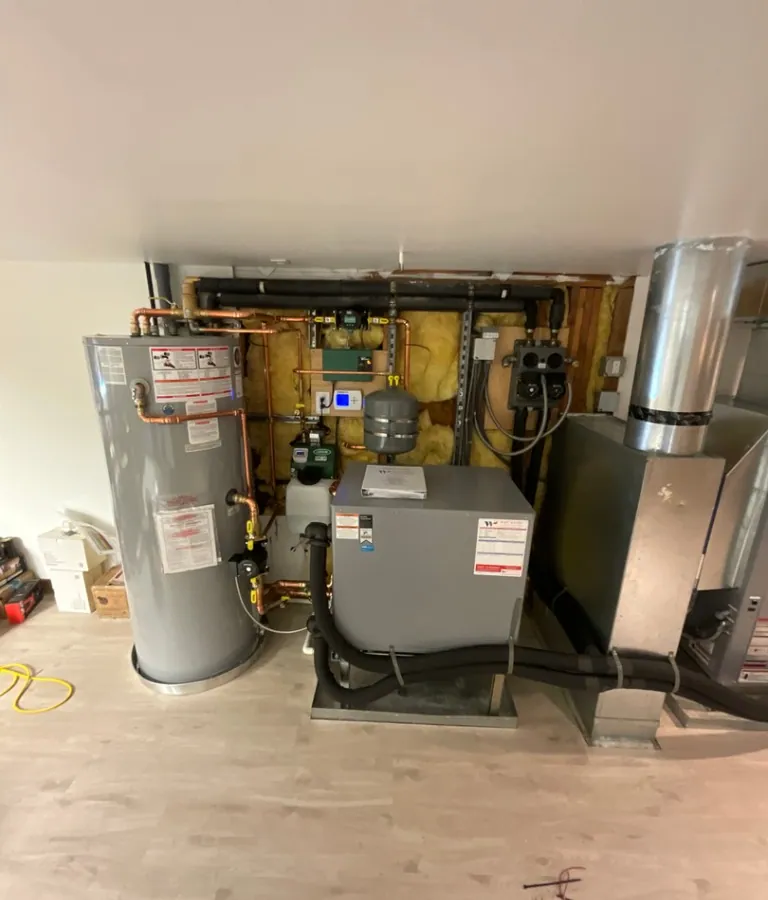
Quick answer: Natural gas boilers run on a utility line, burn cleaner and need less upkeep. Oil boilers suit homes without gas service but need a storage tank, fuel deliveries and more frequent cleaning. Gas availability at your property usually decides it.
How Oil and Gas Boilers Differ
Oil and gas boilers heat water the same basic way; the difference is the fuel they burn and what that fuel asks of you.
Both burn fuel to heat water that circulates through your baseboard, radiators or radiant floors. A gas boiler draws natural gas from a utility line as it needs it. An oil boiler pumps heating oil from a tank, atomizes it through a nozzle and burns it. That difference shapes almost everything else: where the fuel is stored, how often the boiler needs cleaning, how it vents and what your options are when it's time for a new one.
Fuel Supply and Storage
Natural gas arrives through a utility line, while oil has to be delivered and stored on site.
With natural gas, there's no tank to watch and no deliveries to arrange; propane works more like oil, with a tank and deliveries. With oil, you need a storage tank indoors or outside, and someone has to keep it filled, either on a delivery schedule or by checking the gauge. Running out of oil in winter means no heat until the next delivery, and it can pull sediment from the bottom of the tank into the fuel line. Older tanks also need watching for rust and leaks.
Maintenance Needs
Oil boilers generally need more hands-on maintenance than gas boilers.
Oil burns less cleanly than gas, so soot builds up more readily on the burner, nozzle and heat exchanger. A yearly cleaning, along with a new nozzle and fuel filter, keeps an oil boiler running properly. Gas boilers still need yearly service, including burner, ignition, venting and safety checks, but they rarely need the same level of cleaning. Skipping maintenance on either type tends to show up as lower efficiency and more breakdowns. See boiler maintenance for what yearly care covers.
Efficiency
Efficiency depends more on the boiler's design than on the fuel alone.
Both oil and gas boilers come in conventional designs, and condensing models are far more common on the gas side. A condensing gas boiler paired with cooler return water, such as radiant floors, can run at very high efficiency. Conventional oil and gas boilers both run at lower efficiency than condensing models. Your actual running cost also depends on local fuel prices, which change over time, so it's worth comparing current prices for your area rather than relying on a rule of thumb.
Venting
Oil boilers and conventional gas boilers usually vent through a chimney or a power-vent system, while condensing gas boilers vent through plastic pipe.
An oil boiler needs a chimney or other approved venting that can handle its hotter exhaust, and the chimney needs to stay clean and sound. A conventional gas boiler vents in a similar way. A condensing gas boiler produces cooler exhaust and vents through plastic pipe out a side wall or roof, with a drain for condensate. Our guide to condensing vs. cast iron boilers explains the difference in more detail.
Safety Considerations
Both fuels are safe when the boiler is installed and maintained properly, but each has its own warning signs.
With gas, the warning sign is the smell of gas: leave the house and call your gas utility from outside. With oil, watch for fuel smells, smoke or soot around the boiler. If the fuel smell is strong or you see smoke, leave the house and call emergency services from outside; for a faint fuel smell, turn the boiler off at its emergency switch, ventilate the area and call for service. Any fuel-burning boiler should have a working carbon monoxide alarm near sleeping areas.
Converting From Oil to Gas
An oil-to-gas conversion replaces an oil boiler with a gas boiler connected to a gas supply.
The first step is confirming that gas service is available at your property. From there, a conversion usually involves a new gas boiler, a gas line to the boiler, venting suited to the new boiler and connections to your existing heating system. Many homeowners choose a condensing gas boiler at the same time. The old oil tank also needs to be dealt with, following local requirements for removal or decommissioning.
When Keeping Oil Makes Sense
Oil remains a practical choice for many homes, especially where gas service isn't available.
If there's no gas line on your street, an oil boiler is often the most direct way to keep hydronic heat. Oil also makes sense when your current oil boiler and tank are in good condition and a conversion would mean significant work for little change. A well-maintained oil boiler can heat a home reliably, and replacing it with a newer oil boiler keeps your existing tank and venting in use.
Hot Water With Oil and Gas Boilers
Both oil and gas boilers can heat your household water, but the options differ.
With gas, a combination boiler can heat your home and your water from one compact unit, or the boiler can feed an indirect water heater. With oil, an indirect water heater fed by the boiler is common, and some oil boilers have a built-in coil for domestic hot water. If you're replacing an oil boiler and also want a new hot water setup, it's worth looking at both together.
Electric Boilers as a Third Option
Electric boilers skip combustion entirely, which makes them simple to place but dependent on your electrical service.
An electric boiler needs no venting, no fuel line and no tank, and it has no combustion to check. It does need enough capacity on your electrical service, and running costs depend on local electricity prices. Electric boilers often suit smaller homes, additions or homes where neither gas nor oil is practical.
How to Decide for Your Home
Gas availability, the condition of your current equipment and how you feel about deliveries and upkeep usually settle the question.
If gas is available and your oil boiler is aging, a conversion is worth pricing. If gas isn't available, a new oil boiler or a well-maintained existing one is a sound path. West Sound Comfort Systems has been locally owned since 2016, and our owners have served Kitsap County since 1999. We repair, replace and maintain oil boilers and handle oil-to-gas conversions in existing homes across Silverdale, Bremerton, Poulsbo and Port Orchard. See boiler installation and replacement, or contact us and ask for a free estimate.
Frequently Asked Questions
Is gas or oil better for a boiler?
Neither wins everywhere. Gas needs less upkeep and no storage, while oil works where gas isn't available. Gas availability at your property usually decides it.
Can I convert my oil boiler to gas?
Yes, if gas service reaches your property. A conversion replaces the oil boiler with a gas boiler, adds a gas line and suitable venting, and connects to your existing heating system.
What happens to my oil tank after a conversion?
It needs to be removed or decommissioned following local requirements.
Do oil boilers need more maintenance?
Yes. Oil produces more soot, so oil boilers benefit from yearly cleaning plus a new nozzle and fuel filter.
Written by
The West Sound Comfort Team
Kitsap County's locally-owned HVAC, plumbing & electrical experts with 30+ years in the industry.
(360) 564-1187